Why Gyms Moved from Shared Cotton Rolls to Single-Use Towels
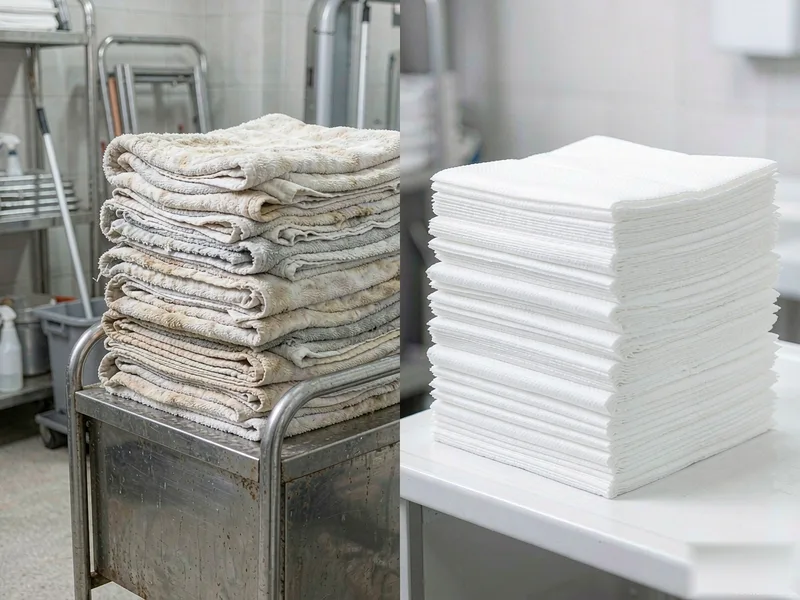
Gyms did not move from shared cotton rolls to single-use towels for one reason; they moved for four that arrived together: the hygiene story around shared-use towels got harder to tell, the laundry cost structure kept growing, the storage math favored sealed packs, and members started reading a fresh towel as part of the service. No single industry figure sums this up — this article lays out the four drivers as a framework, so a club can check which ones actually apply to its building. The staff-side wipe-down cloths are a separate item, covered in the existing guides on sweat cloths for gym floors and disposable washcloths for gym floors; what follows is about the member-facing towel.
The Hygiene Story Changed Before the Product Did
A shared cotton roll works only if every member believes the towel in their hand came out of a hot wash and not out of someone else's session. That belief is a story a club tells with visible cues — hampers, folded stacks, the laundry pickup — and the story got harder to tell as members started comparing the gym to every other service they use. Single-use does not make a towel more hygienic as a blanket claim; it removes the shared-use cycle itself. The towel a member receives has not been on another member, and that fact is visible at the handout, not buried in a wash process nobody sees.
The Laundry Cost Structure, Without the Numbers
A cotton towel program carries a cost structure rather than a price: machine capacity per cycle, drying time and energy, the labor of sorting and folding, the replacement of lost pieces, and — where washing is outsourced — a contract with minimums that keeps small clubs paying for volume they do not use. Each line scales with visits, and none of it appears on the towel's purchase price. A single-use program replaces that structure with one line: pieces issued per day. Clubs that run this comparison are often comparing a predictable total against a variable one, and that difference — not which number is lower — is what usually decides it.
Storage: Par for the Wash Cycle vs. Sealed Packs
Cotton needs depth: enough pieces in rotation to cover every member while yesterday's load moves through wash, dry and fold. The stock is the buffer for a cycle measured in hours and days. Sealed packs invert this. Nonwoven towels in sealed packs hold a shelf life of around 3 years, and an opened pack around 6 months, so a storeroom of sealed cartons is not a risk — it is the reorder buffer itself. The floor-space question also changes: folded nonwoven packs store flat and stack, where a cotton par needs shelving sized to a rotation, plus hamper space in every corner of the floor.
What Members Actually See
A cotton program shows its work: hampers, laundry bags, the same stack refolded. A single-use program shows a sealed pack or a fresh piece at every visit, and members read that as service rather than logistics. That perception is why the front-desk handout — a towel issued at check-in as part of the membership — became the visible form of this shift. It is also why the towel's format started mattering more: a piece handed over at the desk has to feel like a service item, which pushes specifications toward the middle and upper end of the recorded range — 30×50 to 40×80 cm, 40–130 GSM — rather than the cheapest piece that absorbs. How that specification is put together is visible on the fitness industry programs page.
The Two Programs Side by Side
| Dimension | Shared cotton roll | Single-use program |
|---|---|---|
| What a member touches | A piece laundered between users | A piece issued once, to them |
| Restock trigger | Par level for the wash cycle | Days of stock from the issue count |
| Storage form | Rotation shelving plus hampers | Sealed cartons, flat-stacked |
| Day-end work | Sort, wash, dry, fold, restack | Count issued pieces, reorder on the line |
| Failure mode | The wash cycle falls behind peak demand | The order is placed after the reorder line passes |
When the Move Does Not Make Sense
The framework cuts both ways. A small club with an in-house laundry and slack machine hours is carrying costs it has already paid for; a premium club whose branded cotton towel is part of the identity is selling the stack, not hiding it; and a floor where members bring their own towels has neither problem. The move makes sense where visits are high, the laundry structure is the binding constraint, and the towel is being repositioned as a membership benefit. Where none of those hold, single-use is a solution to somebody else's problem.
What Changed on the Buyer's Desk
The shift also changed what a club has to write down. Buying cotton is spot purchasing of a commodity; a single-use program is a specification — size, GSM, pack format — produced to order rather than pulled from shelf stock. At Jaroll, production is make-to-order per project, with no finished-goods stock to draw from, so the program is planned against lead time: usually around 20 working days for a standard private-label run, counted from the later of the deposit and the approved packaging artwork, excluding shipping, confirmed in the written quotation. That is why the usage count and the reorder line matter more, not less, after the switch: the calendar is the new constraint.
The next step is the usage figure: count the pieces issued per day for two weeks, and bring that number to the conversation with Jaroll. The specification work starts there, and the full range — sizes and GSM both ends — is laid out in the recorded towel range.