Spin, HIIT and Strength Classes: Sizing Towels for High-Turnover Sessions
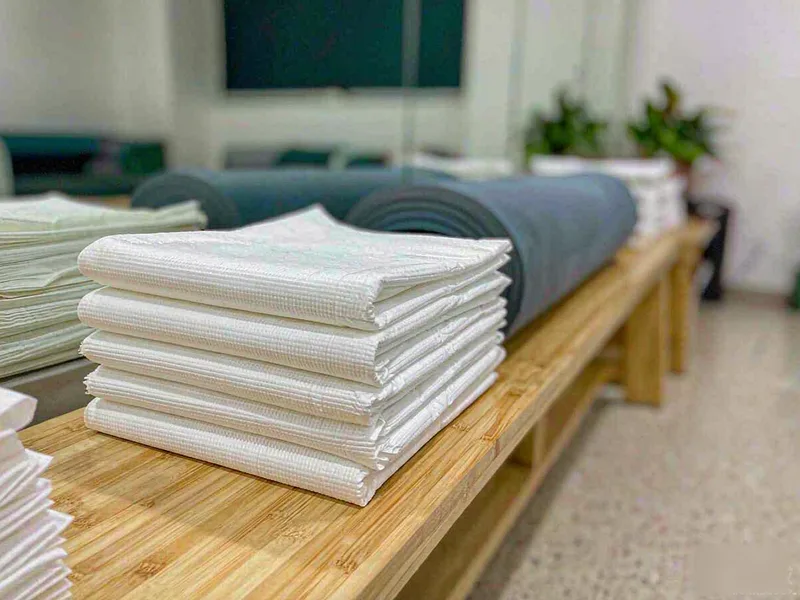
In high-turnover group classes, the towel question changes shape: it is no longer a matter of how many towels the club needs in total, but of how many this class, at this hour, hands to the people who booked it. The answer is small-format pieces issued per participant per session, counted against the timetable rather than the membership list. This article sizes the towel and the daily count by class type — the front-desk handout and its tracking are a separate topic, and so are the wipe-down cloths for machines and gym floors.
Why Classes Change the Towel Question
A scheduled class compresses everything: a fixed slot, a booked list, and minutes of turnaround between sessions. Nobody reuses a towel across participants, so the count is arithmetic — participants times pieces — and the turnaround is a restock problem, not a laundry problem. That is a different consumption model from an open floor, where towels drift out of the building one visit at a time and no timetable ever says how many came out.
Matching the Towel to the Class
The recorded towel range runs 30×50 to 40×80 cm and 40–130 GSM, and both ends of that range have a place in a class program. What matters is pairing the format with what the class actually does to the member.
| Class type | What the member does with the towel | Format considerations | Your spec (fill in) |
|---|---|---|---|
| Spin / indoor cycling | Face and neck wipe, seated, high sweat rate, small area | Smaller end of the size range; a piece that fits beside the bottle cage | ___ cm, ___ GSM |
| HIIT / circuit | Face and hands between stations, fast grab, nothing stored on the person | Small-to-mid format; quick single-hand pickup | ___ cm, ___ GSM |
| Strength | Bench and grip wipe between sets | Mid format; a flat piece that folds under a bottle | ___ cm, ___ GSM |
| Mind-body (yoga, Pilates) | Hand towel for face and mat edge, low turnover | Small format; presentation weighs more than volume | ___ cm, ___ GSM |
The GSM choice inside 40–130 is a trade-off, not a rating: a heavier piece reads as premium at a boutique studio and stretches the budget on a high-frequency timetable. Where a program lands is a project decision worth writing down per class type, because one carton serves all of them only when the timetable is genuinely uniform — and most timetables are not.
Counting a Day of Classes
The daily issuance is arithmetic on the timetable, and the timetable already exists:
| Class slot | Booked / cap | Pieces per participant | Pieces for the slot |
|---|---|---|---|
| e.g. Spin 07:00 | ___ | ___ | ___ × ___ = ___ |
| e.g. HIIT 12:30 | ___ | ___ | ___ × ___ = ___ |
| e.g. Strength 18:00 | ___ | ___ | ___ × ___ = ___ |
| Daily total | Sum of all slots + your safety margin (___%) = ___ | ||
Count booked places, not members: a class program consumes against the timetable, and the timetable is the only number that repeats week after week. Once the daily total exists, the order rhythm follows the logic of any consumable — days of stock on hand, a reorder line, and a storage depth matched to the delivery rhythm.
Staging and Turnaround Between Sessions
Where the towels are staged decides whether the gap between classes works. A carton at the studio door, beside the coach, beats a central station across the floor; a shelf in each studio beats both. Two properties of the product make that staging easy. Packs are sealed with a shelf life of around 3 years, and an opened pack holds its quality for around 6 months — so a studio-side shelf of opened packs is workable, provided opened packs are used before sealed ones. The restock rule stays simple: whatever the slot count says, the shelf carries at least the next two classes.
Where Per-Class Issuance Does Not Fit
Open-floor training does not schedule, so its count moves to the front desk. Clubs running mixed models — classes plus open floor — usually issue the class towel at the studio door and keep the desk handout for everyone else, with separate counts for both. A club whose members bring their own towels may only need the studio shelf for the exceptions. The per-class model earns its paperwork when the timetable, not the floor, drives consumption.
One Specification, Written per Class
The format decision and the count decision land on the same page: a towel specified at the right point of the range for each class, and a daily number built from the timetable. The recorded disposable towel range — 30×50 to 40×80 cm, 40–130 GSM — is where both ends of that trade-off can be compared in one list, and the fitness floor programs page shows how class issuance and floor supply sit together in one specification. When the timetable figure is stable, bring it to the Jaroll team and size the program against real attendance.