The Towel Evidence: What Research Says About Single-Use and Reusable
QINGDAO, China — Every spa director, salon owner, housekeeping manager and groomer eventually meets the same question: cloth towels that go through the laundry, or single-use towels that leave the room with each guest. The debate is usually argued with adjectives. It is better argued with the record, because the peer-reviewed evidence on both sides is specific enough to guide a purchasing decision, and honest enough to disappoint both camps.
The hygiene record
The case for single-use is strongest where laundering is hardest to validate. California nail salons were the site of a large mycobacterial outbreak documented in the New England Journal of Medicine: 110 customers developed furunculosis traced to contaminated whirlpool footbaths [1]. The follow-up investigation found mycobacteria in 97 percent of the footbaths sampled across 30 salons [2].
Barbershops tell a similar story. German hygiene officials traced a cluster of Trichophyton tonsurans scalp infections to a single barbershop, recovering the dermatophyte from clippers, storage drawers and towels [3]. In Guangxi, China, monitoring across six cities found towels were among the least compliant items in barbershops and beauty salons, with bacterial pass rates well below those of instruments [4].
Pet-grooming rooms raise the same stakes. Turkish researchers recovered dermatophytes, including Microsporum canis, from grooming tools collected in veterinary clinics and grooming salons [5]. In Brazil, contamination turned up on 83 percent of the clipping instruments sampled from pet shops, with Malassezia the dominant genus [6].
The environmental ledger
The reusable side of the argument rests on measurable numbers, too. A life cycle assessment of cotton and polyester-cotton fabrics put thousands of liters of irrigation water on every kilogram of cotton fiber [7]. Commercial laundry is equally quantifiable: a study of HORECA laundry services estimated electricity demand of 0.3–0.8 kWh per kilogram of linen, before thermal energy is counted [8]. Washing synthetic textiles also releases microplastic fibers into wastewater, with fabric type and load size driving the amounts [9].
Honesty cuts both ways. A widely cited life cycle assessment of isolation gowns found reusable systems outperforming disposable ones on energy, water and emissions across the use cases modeled [10]. A food-contact study found cellulose cleaning cloths removed more bacteria from surfaces than nonwoven alternatives [11]. None of this makes single-use the default answer. It makes the default answer a question about conditions.
Where single-use earns its place
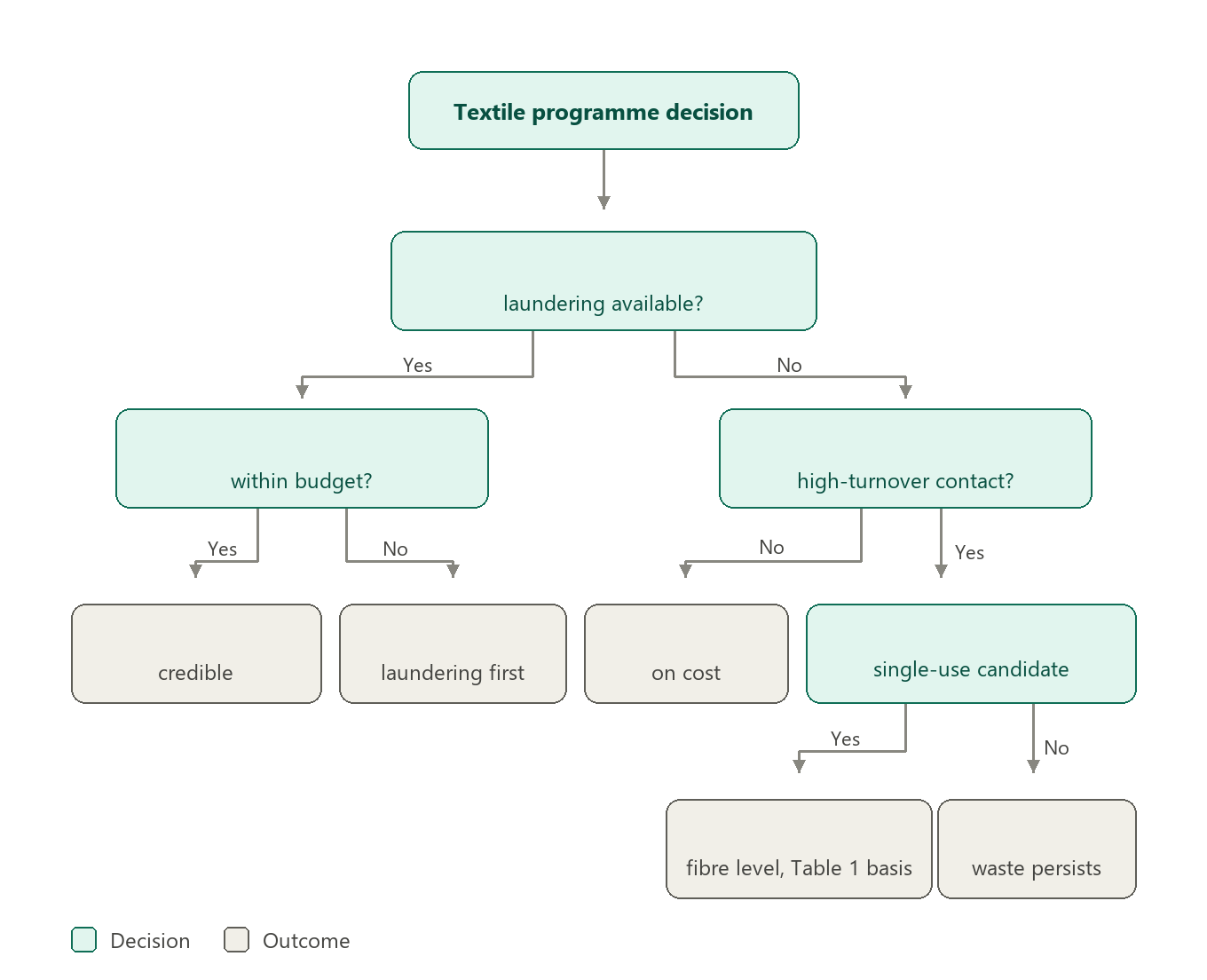
Read together, the studies draw a boundary. Single-use performs best where hygiene-critical contact meets high turnover and no validated high-cycle laundry — the gap between two salon appointments, a spa treatment room, a grooming table between dogs. Where a large, professionally operated laundry exists and its energy and water budgets hold, reusable programs remain credible [10]. The material evidence matters here as well: regenerated-cellulose spunlace grades degraded at rates similar to native cellulose across ecosystems in recent testing [12], while synthetic grades persist [9].
A checklist for buyers
The questions drawn from the studies above are what a buyer can put to any towel supplier, Jaroll included:
- Is your laundering validated for high-cycle use? If not, the hygiene record favors single-use at the point of contact [1].
- Does laundry energy and water per kilogram of linen fit your operating budget [8]?
- Where biodegradability is a requirement, is the fiber cellulose-based [12]?
- Is the basis weight matched to the task — heavier grades for wet-load duty, lighter grades for drying and finishing [13]?
QINGDAO JAROLL HYGIENE PRODUCTS CO., LTD. manufactures spunlace nonwoven towels at approximately 50 million towels per month, in basis weights from 40–130 g/m², for hospitality, salon, spa and pet-grooming programs. The manufacturing range is listed at spunlace nonwoven.
Sources
- New England Journal of Medicine, 2002. An outbreak of mycobacterial furunculosis associated with footbaths at a nail salon. https://doi.org/10.1056/NEJMoa012643
- Emerging Infectious Diseases, 2005. Mycobacteria in nail salon whirlpool footbaths, California. https://doi.org/10.3201/eid1104.040396
- Hygiene & Medizin, 2024. Trichophyton tonsurans infections after visiting a barbershop — findings from official hygiene monitoring. https://pmc.ncbi.nlm.nih.gov/articles/PMC11565591/
- Journal of Environmental Hygiene, 2023. Monitoring results of health hazard factors at barbershops in 6 cities of Guangxi Zhuang Autonomous Region, China, 2021. https://doi.org/10.13421/j.cnki.hjwsxzz.2023.05.013
- Journal of Small Animal Practice, 2010. Recovery of dermatophytes in pet grooming tools from veterinary clinics and pet grooming salons. https://doi.org/10.1111/j.1748-5827.2009.00856.x
- Scientific Electronic Archives, 2021. Mycotic zoonoses risk from clipping instruments in pet shops in Sinop – MT. https://doi.org/10.36560/141020211439
- Autex Research Journal, 1999. Life cycle assessment: Environmental profile of cotton and polyester-cotton fabrics. https://doi.org/10.1515/aut-1999-010102
- Energy Demand, 2026. Discounted LCA and economic assessment of heat pumps and PV in HORECA laundry services. https://doi.org/10.66506/ed.43
- Marine Pollution Bulletin, 2016. Release of synthetic microplastic plastic fibres from domestic washing machines. https://doi.org/10.1016/j.marpolbul.2016.09.025
- American Journal of Infection Control, 2018. Environmental considerations in the selection of isolation gowns: A life cycle assessment of reusable and disposable alternatives. https://doi.org/10.1016/j.ajic.2018.02.002
- Food Control, 2013. Comparison of cleaning fabrics for bacterial removal from food-contact surfaces. https://www.sciencedirect.com/science/article/abs/pii/S0956713512003374
- bioRxiv, 2025. Native and regenerated cellulose show similar environmental biodegradation behavior across global terrestrial and aquatic ecosystems (preprint). https://doi.org/10.64898/2025.12.24.696393
- The Journal of The Textile Institute, 2021. Effect of material properties and process parameters on properties of hydroentangled nonwoven fabrics. https://doi.org/10.1080/00405000.2020.1791398