Mobile Grooming Vans: Counting Disposable Towels for a Day of Appointments
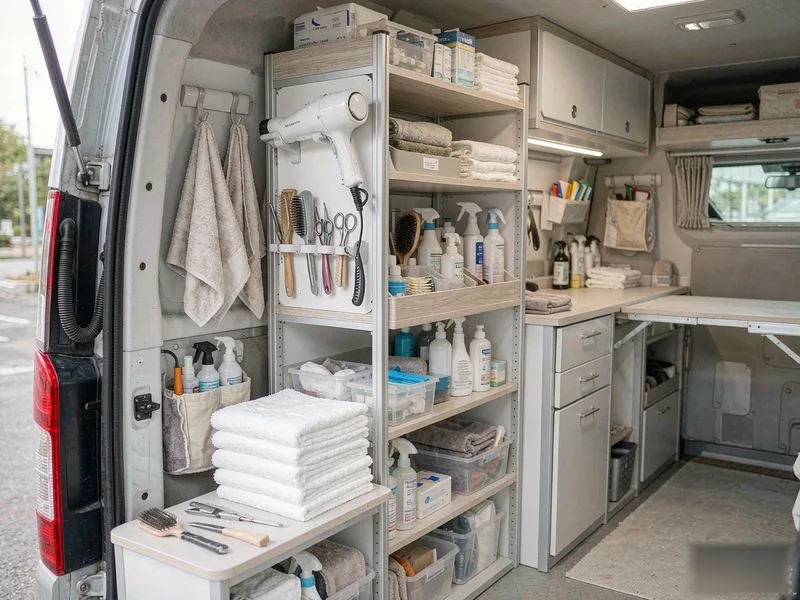
In a mobile grooming van, tomorrow's towel count is set tonight, by the appointment book. The arithmetic is short — towels per dog multiplied by the day's appointments, plus a buffer — but the van adds constraints a salon never meets: no stockroom, no laundry on board, and every pack that leaves the depot has to fit in a bin. Boarding kennels, covered earlier on this site, count towels by the length of the stay; a van counts by the day's appointments, and that different unit changes everything about how the stock is planned.
Why the Van Changes the Count
A salon can run to a shelf in the back room; a van cannot. Towel stock in a van competes for space with water tanks, a table, a dryer and the rest of the consumables, so the question is not just "how many towels" but "how many towels in how much volume." There is also no resupply mid-route unless the schedule deliberately passes the depot, which means the buffer has to be carried, not ordered. The upside is symmetry: whatever is not used stays on board, and sealed packs roll straight into the next working day.
The Count, as a Fill-In Formula
| Line | How to fill it in |
|---|---|
| Towels per appointment | From your own records; more accurate if split by size or coat class (small dog ___, large dog ___) |
| Appointments for the day | From tomorrow's booking list |
| Base count | Towels per appointment × appointments |
| Buffer | Your own rule, for example one extra towel per appointment |
| Day total | Base count + buffer |
Worked example, with every number marked as a fill-in rather than an industry average: if your logs show 4 towels per small dog and 6 per large dog, and the book holds four small dogs and two large ones, the base count is 4 × 4 + 6 × 2 = 28. A one-per-appointment buffer adds 6, for a day total of 34. Replace any part of that arithmetic with a number you cannot source from your own records and the total stops describing your van.
From Count to Van Stock
The day total becomes shelf stock through pack arithmetic. Packs are configured per SKU, so divide the day total by the pieces per pack of the SKU you run, and round up — a sealed pack is never waste, because it carries over. In practice, most vans settle into a two-zone split: one opened pack lives in the working bin beside the table, and sealed packs live in a fixed dry bin away from the bathing zone. If the packs are resealable — a format worth stating when a specification is written — the opened pack closes between appointments.
One refinement worth building into the log from the start: record the per-dog figure by service, not by dog. A bath-and-brush appointment and a full groom on the same dog do not consume the same towels — a full groom runs longer under the dryer and adds finishing touches — and a booking list that mixes both service tiers will make a single average drift. Two lines in the log — service type, towels used — are enough. After a few weeks the fill-in table gains one row per service tier, and the count tightens without extra effort.
Where the Formula Stops Working
No-shows and same-day cancellations do not consume towels — sealed packs carry forward untouched. Coat condition does move the count: a dog that arrives wet from rain or muddy from a walk consumes more at the first drying pass, which is where a buffer earns its place. And the formula is a planning tool, not a measurement: the real consumption figure comes from a short end-of-day log, and after a few weeks that log replaces every estimate in the table above.
When the Count Outgrows the Van
If the day total regularly exceeds what one bin holds, the answer is operational, not mystical. The options: revisit the per-dog number stage by stage, because overcounting hides in the split between first pass, press and finish; or schedule a mid-week restock at the depot; or both. The one move that never works is stocking for the busiest possible day in the smallest possible bin and discovering the conflict at 8 a.m.
The Specification Side of the Count
Which weight and size to load follows the same recorded range as any pet towel program: 40–130 GSM in towels sized 30×50 to 40×80 cm. The disposable pet towel range records what is available, and the pet industry overview covers where single-use towels fit across grooming operations. For a van, the deciding questions are pack count per SKU and pack volume — both belong in the specification before the first carton is loaded, not after the first bin overflow.
Start with tomorrow's book: fill in the four lines of the table, and the count is done in five minutes. When the per-dog numbers settle and the pack format question needs an answer, contact Jaroll with your day total and the bin it has to fit.