The Three Drying Stages in a Pet Grooming Shop: Where Each Towel Does Its Job
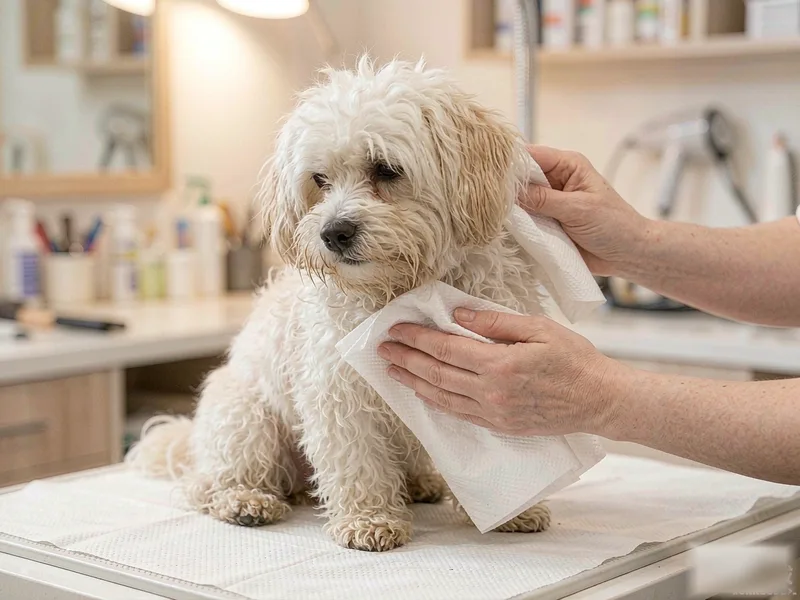
Drying a dog after the bath is not one job but three: a first pass that takes off most of the water, a pressing stage that locks in what the first pass missed, and a finishing stage that runs alongside the dryer. Guides on this site have already covered how to write a pet towel specification and where towels sit around the salon; this article stays inside the drying sequence itself — what each stage asks of the towel, which recorded weights and sizes fit, and how to turn the stages into a per-dog count.
Stage 1: The First Pass Right After the Bath
The dog leaves the tub carrying most of its water in the coat, and the first towel has to carry it away. This is the heaviest workload in the sequence, and it is where the upper end of the recorded 40–130 GSM towel range earns its place: a heavier piece moves more water per piece, which means fewer swaps mid-dog. On the largest coats, the longer formats recorded in the disposable pet bath towel range cover more coat per pass.
Size works in the same direction. The recorded towel range runs from 30×50 to 40×80 cm, and at this stage the larger formats do more per pass — one sweep down the back of a large dog at 40×80 cm covers what a smaller piece manages in two. For most dogs, planning two towels at this stage is reasonable rather than extravagant: the water is there, and it has to go somewhere.
Stage 2: The Press, Before the Dryer Starts
After the first pass the coat is damp rather than wet, and the job changes character. The second stage is pressing, not wiping: lay the towel flat against the coat, press, lift, move on. Wiping a damp coat mostly moves water around; pressing transfers it into the towel.
Because the water load is lower, the towel does not need the carrying capacity of stage one. A mid-weight piece within the recorded 40–130 GSM range is usually enough here, and the smaller formats in the recorded 30×50 to 40×80 cm range are easier to handle against a leg or a chest. The press is also the calmer stage for the dog, which is one more reason to finish it properly before the dryer noise starts.
Stage 3: The Finish Beside the Dryer
While the dryer runs, a third towel handles everything the airflow does not reach efficiently: the face, the ear folds, the paws, the armpits. These are small surfaces, and the towel for them can be the lightest and smallest in the recorded range — a 30×50 cm piece covers a paw or wraps an ear. This towel lives in the groomer's belt or at the table edge, and it is the one most often grabbed one-handed, so the pack it comes from should sit within reach rather than across the room.
The Whole Sequence in One Table
| Stage | Water load | Towel weight (recorded range: 40–130 GSM) | Useful size (recorded range: 30×50 to 40×80 cm) | What the stage is for |
|---|---|---|---|---|
| First pass | Bulk of the bath water | Upper end of the range | 40×80 cm where coverage matters | Removing most of the water before the dog leaves the tub area |
| Press | Residual dampness | Middle of the range | 30×50 to 40×80 cm | Locking in the remaining water so the dryer starts from damp, not wet |
| Finish | Small surfaces and touch-ups | Lower end of the range | 30×50 cm | Face, ears and paws during and after drying |
Turning the Stages Into a Per-Dog Count
Once the sequence is explicit, the count writes itself — from your own records, not from an industry average. The template:
- First pass: ___ towels per dog
- Press: ___ towels per dog
- Finish: ___ towel per dog
- Towels per dog = first pass + press + finish
- Towels per day = towels per dog × appointments on the book
Worked example, with every number marked as your own fill-in: if your records show 2 + 1 + 1 for a medium coat and tomorrow's book holds eight dogs, the day runs 4 × 8 = 32 towels. The moment any number in that sum comes from somewhere other than your own log, the total stops describing your shop.
Where the Three-Stage Framing Breaks Down
The stage split assumes a hand-drying-plus-dryer workflow. Coat type moves the per-dog count more than any specification choice: a double-coated dog can double the first-pass figure, while a very short coat may not need a press stage at all. Very small dogs sometimes collapse the sequence into a single towel, and shops that rely almost entirely on forced-air drying shift their mix toward the first and third stages, with the press reduced to the legs and belly. None of this changes the recorded specification range — 40–130 GSM, 30×50 to 40×80 cm — it only changes how many pieces of it each dog consumes.
Specifying Towels for the Sequence
A shop that stocks one towel for all three stages pays for upper-end weight at the finish, where it is not needed. The disposable pet towel range covers the whole sequence within one product family, and the pet grooming overview describes where single-use towels fit across the workflow. If you are building a specification rather than picking from a shelf, state the weight band and size per stage, and let the count come from your records.
The next step is small: write down your own three numbers — first pass, press, finish — from this week's logs, and the per-dog count is done. To compare those numbers against the recorded specification range, contact Jaroll with the stage that consumes the most pieces.