What an Individually Wrapped Bath Towel Changes in a Guest Room
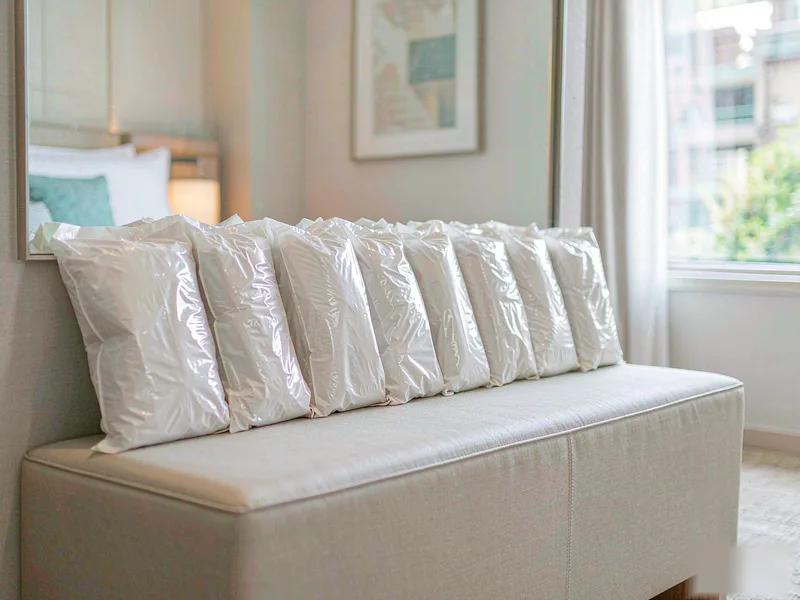
A wrapped bath towel is not a folded bulk towel with an extra layer around it. Inside the guest room, the wrapper changes four things at once: the signal the guest reads before opening, what housekeeping can put on open display, the unit the stock is counted in, and how the storage volume behaves per piece. This article stays inside the guest-room scene. How to choose between pack formats when the whole order is on the table is a separate conversation, and so is the use of wrapped towels on home-care visits — neither is repeated here.
The Signal Before Opening
An intact wrapper is a verifiable state: this piece has not been touched since it left the packing line. The guest does not have to take the room attendant's word for it — the wrapper says it instead. Sealed stock holds that state for about three years, which is also the rotation horizon for display pieces: what goes on the shelf first comes off the shelf first. Once a pack or carton is opened for replenishment, the opened stock carries about six months, so the pieces pulled for rooms should come from cartons already opened, not from sealed reserve.
One boundary worth writing down: the wrapper signals untouched, not sterile. No clinical claim travels with a wrapped towel, and none should be printed on it.
What Becomes Displayable
Folded bulk lives in closed storage — a pantry, a cart with a lid. A wrapped piece can sit in the open: on the bathroom shelf, folded at the foot of the bed, or in a basket by the tub. That difference is what makes the wrapper a room-standard decision rather than a packing detail. If the room standard includes visible amenities, the wrapped format is the one that can carry them.
The wrapper is also the printable surface. In a private-label program, the artwork lives on the wrapper, not on the towel, which keeps the presentation decision and the branding decision on the same object.
The Count Unit Becomes the Piece
Bulk stock is counted in bags or cases; wrapped stock invites counting in pieces, because the piece is now a closed unit. Two operational habits follow. The room attendant records pieces placed and pieces recovered unused, which makes the room itself a counting point. And an unused wrapped piece can return to stock — the intact wrapper still certifies the piece — while a bulk towel taken from an open pack cannot make that claim.
The daily issue figure comes from the property's own numbers, not from a published rate:
| Step | Figures to fill in | Your property |
|---|---|---|
| Occupied room-nights per day | rooms × occupancy | ___ × ___ |
| Pieces per occupied room per day | from the room standard | ___ |
| Daily issue | row one × row two | ___ |
| Recovered unused per day | from attendant records | ___ |
The last row is the one the wrapper makes possible, and it is the row that corrects the room standard over time.
Folded Volume and the Storeroom
The wrapper does not change the towel: a bath towel format of 100 to 150 cm at 40–130 GSM occupies the same towel it occupied before wrapping. What changes is the space around it. Each wrapped piece adds its wrapper and its fold allowance, so pieces per shelf, per carton and per pantry slot all shift, and the per-project numbers — pieces per carton, cartons per pallet — are confirmed in the written quotation rather than assumed. Properties with small floor pantries feel this first: the wrapped program buys presentation and countability by paying in storage volume.
What the Wrapper Does Not Change
- Coverage. A wrapped 100 cm piece and its bulk twin dry the same guest. If the room program is driven by coverage per room tier, decide the size and the position inside 40–130 GSM first, and the wrap second.
- Wet performance. What the towel does when soaked is a property of the towel, not of the packaging; it is a sample-and-specification question either way.
- The spec sheet fields. Material, GSM, size and fold appear on the specification the same way in both pack formats.
Where It Does Not Fit
- High-turnover hand-out points. At a pool desk moving pieces by the dozen, the wrapper adds an opening step and volume without a display job to do; folded bulk usually wins there.
- Storage-constrained properties. Where the pantry is already tight, the volume premium of wrapping shows up before any of its benefits do.
- Programs with no presentation standard. If towels live in closed storage by policy, the wrapper's display and signal functions are unused, and the pack format decision collapses back to a storage calculation.
From the Room to the Order
The guest-room case for the wrapped format rests on the signal, the display and the piece-level count — with the storage volume as the cost to plan for. The individually packed disposable bath towel page carries the format itself, the individually packed towel range shows where else single-piece wrapping is used, and the bath towel range is where the size and GSM decisions behind it are made. The hospitality program page places the format in the wider hotel context. The next step is to fix the room standard first — size, GSM, pieces per room — and then put the wrapped version of that standard into one inquiry through contact.