How Japan, Korea, and Northern Europe Are Approaching Senior Care Disposables Differently
How Japan, Korea, and Northern Europe Are Approaching Senior Care Disposables Differently
Senior care is often talked about as one global market. It is not. The way each region treats disposable towels in care settings reflects its healthcare system, its labor market, and its environmental politics.
Japan — protocolized, standardized, and quietly scaled.
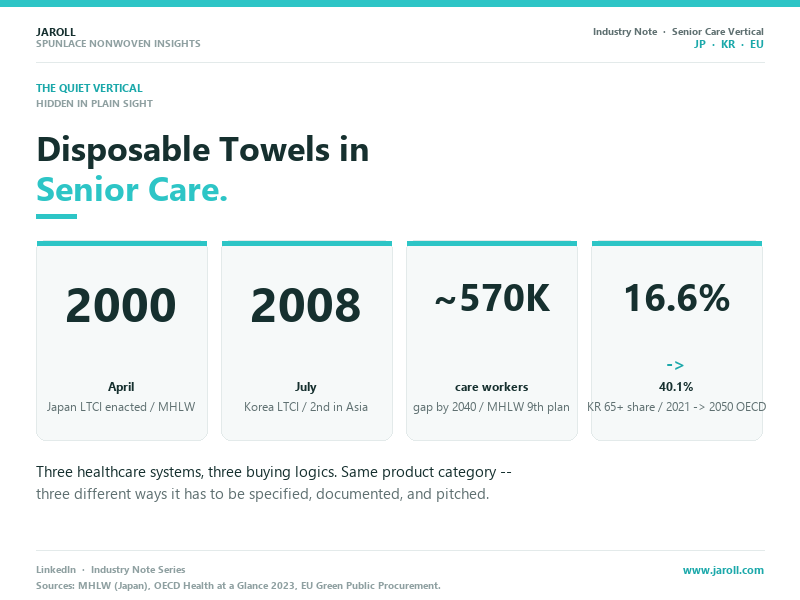
Long-term care insurance (介護保険), introduced in April 2000 by the Ministry of Health, Labour and Welfare, defines a basket of eligible services and reimbursement rules. The service catalog includes bathing assistance, partial bathing, incontinence care, and oral care — categories under which disposable towels fit into facility workflows. Compliance documentation is part of the procurement process. The labor backdrop is tight: the MHLW's 9th Long-Term Care Insurance Business Plan (2024) projects a need for about 2.72 million care workers by 2040, against roughly 2.15 million today — a gap of ~570,000. That is the structural reason facilities are looking at workflow simplification.
Korea — moving fast, brand-led.
Korea introduced universal long-term care insurance in July 2008, about eight years after Japan. The formal sector is younger. Per OECD, Korea will move from 16.6% (2021) to a projected 40.1% (2050) in share of population aged 65+ — the fastest shift among OECD members, taking a demographic transition that took France 115 years and compressing it into roughly three decades. Buying behavior in this window tends to lean on presentation and brand cues over protocol. The supply side is catching up; the demand side will not wait.
Northern Europe — disposable is welcome, but the question is "how much."
In Germany, the Netherlands, and the Nordics, disposables are accepted in care settings, but the procurement conversation is increasingly framed by environmental and supply-chain criteria. The EU's Green Public Procurement framework, the Swedish National Agency for Public Procurement's sustainability criteria for medical consumables, and tenders like the 2021 Stavanger region medical-consumables framework (Norway) all show the same direction: ISO 14001 / EMAS, supply-chain due-diligence, fiber and material disclosure, and life-cycle climate data are scored at award stage. A supplier that can answer those questions clearly has a structural advantage; one that cannot, gets deprioritized.
What this means for a brand launching regionally.
• For JP: spec fit and protocol documentation are the sale
• For KR: brand presentation and packaging are the sale
• For Northern Europe: environmental and supply-chain data are the sale
Do not launch one SKU across all three. The product has to be re-specified, re-documented, and re-pitched for each one.
—
A regional note from the Jaroll team, working with distributors and brand owners across JP, KR, and selected EU markets. The structural differences above are drawn from public policy and labor data, plus our own field conversations — not from any single market study.
Sources.
• LTCI Japan introduction & service catalog: Ministry of Health, Labour and Welfare (MHLW), Kaigo Hoken Seido ni Tsuite.
• Care-worker demand projection: MHLW, Daiki Kaigo Hoken Jigyo Keikaku ni Motozuku Kaigo Shokuin no Hitsuyosu, 2024 (9th plan).
• Korea LTCI launch & demographic shift: OECD Health at a Glance 2023; KEIA Improving Korea's Long-Term Care for the Elderly; ERIA Coping with Rapid Population Ageing in Asia.
• EU/Nordic procurement criteria: European Commission Green Public Procurement good-practice library (Stavanger 2021 case); Swedish National Agency for Public Procurement, medical consumables criteria.