Global Disposable Facial Towel Industry Report 2026
A facial towel is sold in adjectives and bought in numbers. GSM appears on four of 121 international product pages. Forty name no fiber at all. Thirty-seven describe a surface; eighty-four describe nothing. This report reads 132 product specifications from seven markets — 121 international records across the United States, the United Kingdom, Germany, Japan, South Korea and the UAE, plus 11 China comparison records — and publishes every count, median and range behind those three sentences.
Jaroll Hygiene Research Team · QINGDAO JAROLL HYGIENE PRODUCTS CO., LTD. · Retail collection October 12–18, 2026 · Published October 2026
Download the report: Global Disposable Facial Towel Industry Report 2026, PDF, 27 pages · international dataset, CSV · China comparison, CSV
Every figure below can be reproduced from the data files named in the appendix. Section 14 lists all 32 sources with the scope each one supports; Section 5 is the only place where numbers from outside this dataset appear.
1. Executive summary
1. GSM, the number a buyer asks for first, appears on four of the 121 international records. The China comparison adds two. Six out of 132 is the disclosure rate for the one specification that decides material cost.
2. Forty of the 121 records name no fiber at all. Another 37 name a fiber without a ratio. Forty-four state a full percentage, which is 36% of the panel, and the remaining pages sell on adjectives such as "plant-based" or "pure cotton".
3. Texture is worse than fiber. Thirty-seven records describe a surface and 84 describe nothing. Of the 37, ten say only "embossed" and ten say only "textured" or "double-sided"; eight use pearl or EF wording. No market has a controlled vocabulary for surface structure, so none of those words is a specification until a sample or a photograph is attached to it.
4. Sheet area varies by a factor of 1.8 within one product category. The captured median is 400 cm² in Japan and 720 cm² in Germany. Both are medians of the pages we opened, not national averages.
5. The pack is more standard than the sheet. Median base-pack count is 50 in the United States, the United Kingdom, Germany and the UAE, and 60 in Japan and South Korea. China's retail median is 80. Offer totals, which multiply base packs, reach 800 sheets and are regularly mistaken for pack counts.
6. Price moves more than size, and it moves differently depending on the denominator. Median listed price per sheet runs from EUR 0.118 in Germany to GBP 0.360 in the United Kingdom, a gap of 3.0 times. Normalised for sheet area it narrows to 2.4 times: EUR 0.197 against GBP 0.465 per 1,000 cm². Neither figure is a market level.
7. Channel alone moves a median by 7% with no product change. In the UAE, 17 price pairs give 1.26 AED per offered sheet; removing eight identified purchase agents leaves nine pairs at 1.18 AED.
8. Growth is the weakest evidence in this category and the most confidently quoted. No official statistical series for facial towels exists in the United States, the United Kingdom, South Korea or the UAE. Where official numbers do exist they describe the substrate rather than the product: European nonwovens output fell 2.2% in 2025, Chinese spunlace rose 8.1% in 2024, Japanese domestic output fell 4.9%. Four commercial forecasts of the same category put 2025 at USD 0.49 billion, 2.15 billion and 2.31 billion, with a fourth whose country totals exceed USD 5.6 billion. The largest base year is 4.7 times the smallest. The direction is agreed; the number is not.
The practical reading is narrow. A facial towel quotation can be compared on six fields — fiber ratio, sheet dimensions, measured GSM, base-pack count, container, price basis — and on nothing else until those six are on the page.
2. The regional picture in two tables
Three quotations for the same job usually arrive in three languages. One says "XL, 80g, soft". Another says "20 × 20 cm, 100 sheets, pearl". A third says "biodegradable viscose, 60-count". None can be checked against the others, and the cheapest per pack is frequently not the cheapest per usable sheet.
Two tables carry the regional comparison. The first holds what the pages declare about the product; the second holds what they declare about the money. Read across a row rather than down a column. Currencies are not converted, and every figure is a median of the records in that cell, not a median of the market. "None" in the fiber column counts records whose wording cannot be resolved to a named fiber — plant-based, cellulose, bamboo, or silence.
| Market | Dominant fiber wording (records) | GSM stated | Texture wording captured | Median sheet area cm² | Median base-pack count |
|---|---|---|---|---|---|
| United States | Rayon/viscose 8, cotton 4, none 8 | 1 of 20 | 7 of 20 | 623.04 (n=14) | 50 (n=19) |
| United Kingdom | Rayon/viscose 8, cotton 4, none 9 | 0 of 21 | 1 of 21 | 696.77 (n=14) | 50 (n=18) |
| Germany | Rayon/viscose 5, cotton 4, lyocell 1, polyester 1, none 9 | 2 of 20 | 8 of 20 | 720.00 (n=9) | 50 (n=18) |
| Japan | Pulp/rayon 7, cotton 6, rayon 5, cotton/rayon 1, none 1 | 0 of 20 | 12 of 20 | 400.00 (n=19) | 60 (n=19) |
| South Korea | Cotton 10, rayon/viscose 6, none 4 | 1 of 20 | 1 of 20 | 575.00 (n=4) | 60 (n=18) |
| UAE | Rayon/viscose 7, cotton 4, none 9 | 0 of 20 | 8 of 20 | 437.81 (n=9) | 50 (n=18) |
| Market | One-pack price n / median | Price per sheet n / median | Price per 1,000 cm² n / median | Packaging forms captured | Brands observed |
|---|---|---|---|---|---|
| United States | 17 / 12.99 USD | 18 / 0.2480 USD | 13 / 0.3356 USD | 10 | 11 |
| United Kingdom | 13 / 15.00 GBP | 16 / 0.3599 GBP | 11 / 0.4650 GBP | 11 | 14 |
| Germany | 11 / 8.93 EUR | 14 / 0.1183 EUR | 6 / 0.1972 EUR | 6 | 14 |
| Japan | 7 / 600 JPY | 7 / 6.0000 JPY | 7 / 15.00 JPY | 9 | 4 |
| South Korea | 1 / 8,500 KRW | 12 / 90.6250 KRW | 2 / 203.65 KRW | 4 | 16 |
| UAE | 15 / 60.00 AED | 17 / 1.2600 AED | 9 / 1.8891 AED | 9 | 13 |
The rows are not interchangeable, and that is the finding.
Japan is the only panel where disclosure is the rule: 19 of 20 records name a fiber, 12 name a surface, and the median sheet is 400 cm² at 60 sheets. Small sheet, many sheets, printed specification. Germany goes the other way on geometry — a 720 cm² median sheet, the largest in the panel — and yet records the lowest unit price, EUR 0.118 per sheet and EUR 0.197 per 1,000 cm². A bigger sheet does not mean a dearer one when the fiber, the pack and the channel differ.
The United Kingdom is the expensive and quiet market: the highest per-sheet median at GBP 0.360, with one texture statement and no GSM anywhere in 21 records. South Korea is cotton-led, 10 of 20, and thin on dimensions — only 4 of 20 records carry a usable sheet area, so its 575 cm² median should not be quoted as a Korean size. The UAE has the second-smallest captured sheet at 437.81 cm², the highest unit price at 1.26 AED, and the only panel where purchase agents materially move the median. The United States sits in the middle on every measure and is the most consistently captured: 18 price pairs, 19 pack counts, 14 dimensions.
China's 11 records are not a market panel and are not pooled with the six. They are consistent with the pattern a domestic buyer would recognise: cotton leads, 5 of 11; retail packs run to a median of 80 sheets; the median listed price is CNY 0.145 per sheet; and texture is the best-captured field of the whole study at 8 of 11, mostly pearl. China is where the product is most often described and least often measured.
3. Specification, market by market
Six fields decide whether two quotations can be compared. They are not equally disclosed, and the inequality is the more useful result than any single median. Missing fields stay missing: an offer total never becomes a pack count, and a plant-based label never becomes a fiber recipe.
3.1 Fiber: the label answers a different question than the buyer asks
Four variables get used as if they were one. Sales destination, brand background, fiber feedstock and manufacturing origin are separate facts. "USA cotton" describes feedstock, not where the towel was made. A towel sold in Tokyo says nothing about where it was spun. The German retailer Your Kaya lists Poland as the country of origin while delivering in Germany, and that stays recorded as an unverified retailer label rather than a fact.
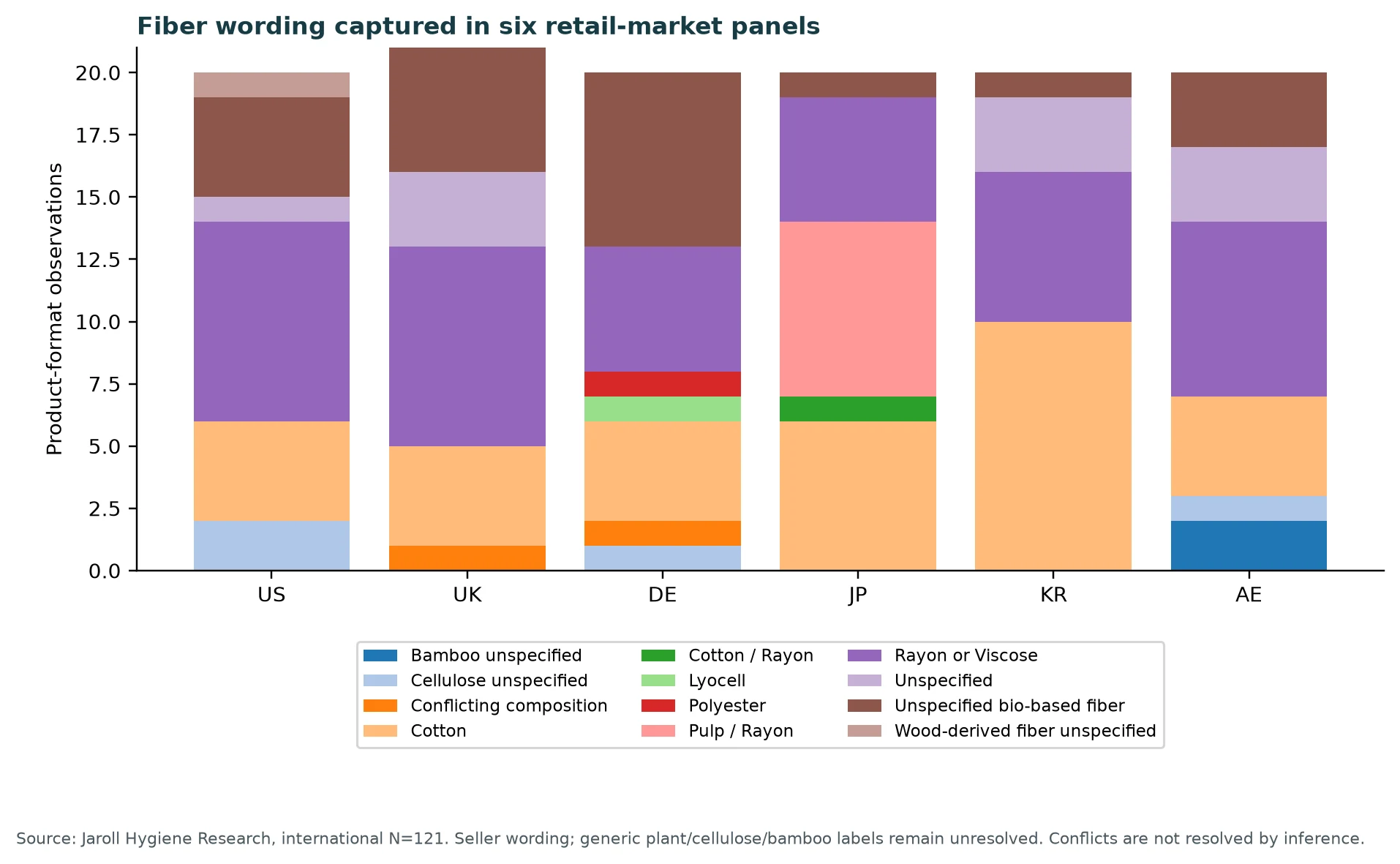
Rayon or viscose is the largest resolved group at 39 of 121 international records, cotton follows at 32, and pulp with rayon — mostly in the Japanese selection — at 7. Another 40 name only a category: plant-based, cellulose, bamboo, or a certification that implies feedstock without naming a fiber. Forty-four records state a percentage. The rest name something and leave the ratio out, which is enough for a marketing page and not enough for a purchase order.
Japan is the exception, with 19 of 20 records naming a fiber, against 11 of 20 in Germany and the same in the UAE. That is a property of the pages we opened and not a transparency ranking of three countries. Frequency in this panel says nothing about performance, cost or environmental profile.
3.2 GSM: the least published number in the category
Explicit area-based GSM appears six times in 132 records. US11 at 65, DE17 at 65, DE18 at 80, KR13 at 70, CN05 at 80 and CN06 at 80. Three of the six are seller declarations that were never tested. A bare "80g", a product weight, a carton weight and a three-dimensional package measurement were all rejected as substitutes.
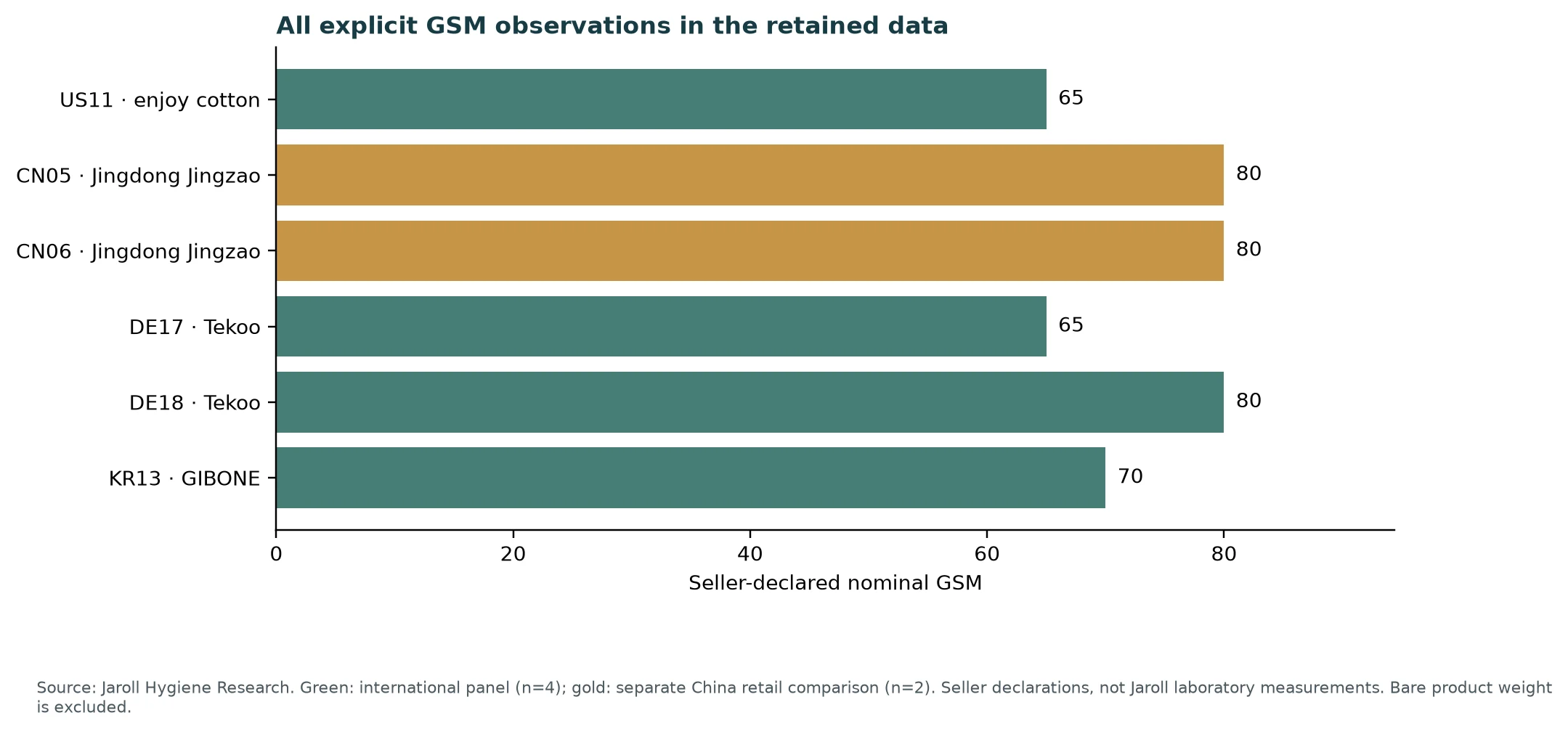
Four international observations support no distribution, no range and no GSM-price model. What they do support is a warning about how the number is used. Take a 25.4 × 30.48 cm sheet at 50 GSM: it carries 3.871 g of web. A 20 × 20 cm sheet at 80 GSM carries 3.2 g. The 50 GSM product uses more material than the 80 GSM product, and a comparison made on GSM alone reverses the ranking. Section 9 works the arithmetic through.
3.3 Texture: vocabulary, not geometry
Thirty-seven of the 121 international records say anything about surface structure. The other 84 are silent, and a quarter of the records that do speak use a word that cannot be turned into a specification. Ten say "embossed" and stop. Ten say "textured" or "double-sided" and stop. Eight use pearl, EF or a combination of the two. Three say plain, three say waffle, two say dot, one says honeycomb.
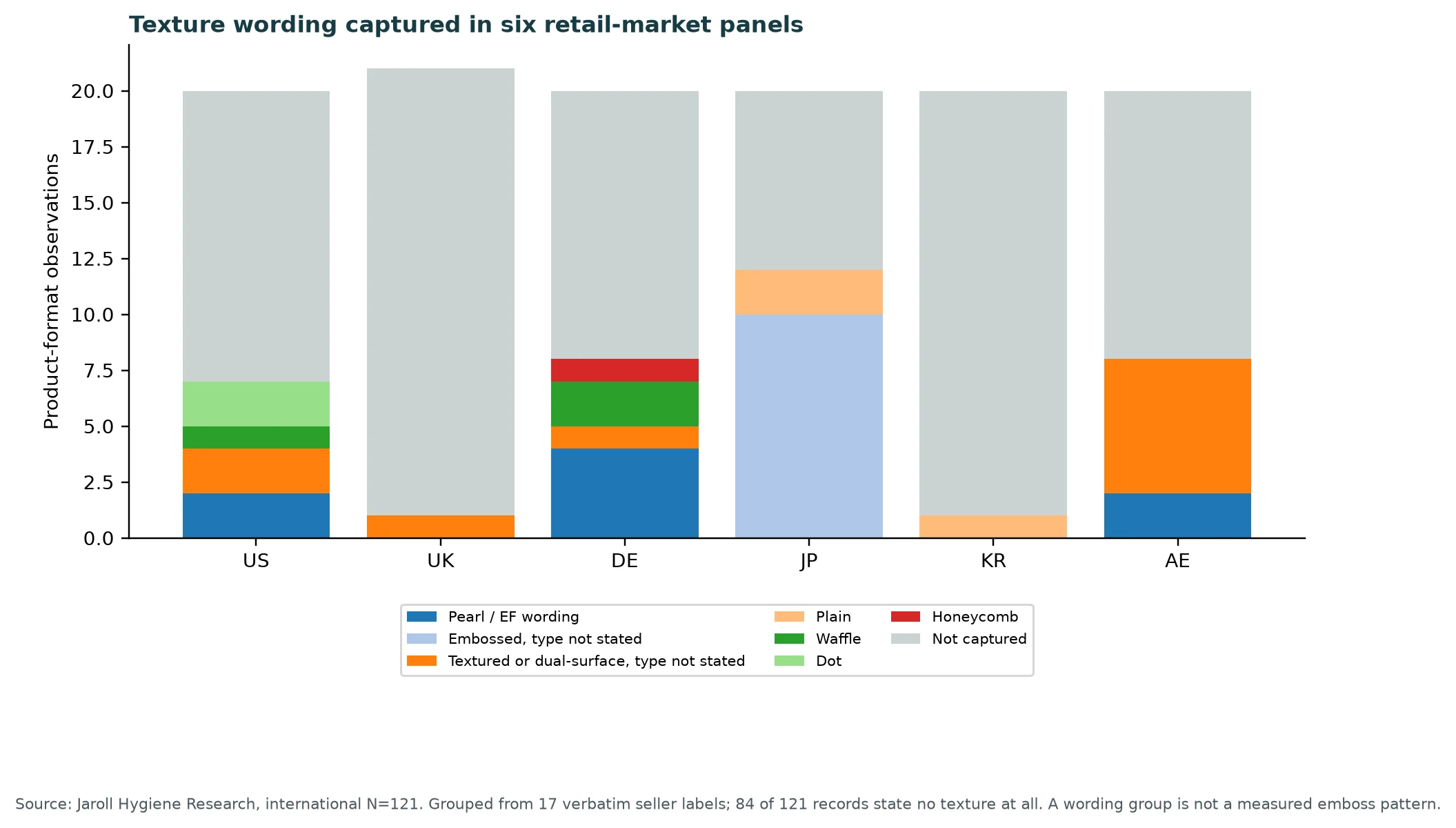
The distribution is a map of local retail language rather than of product design. Ten of Japan's twelve texture statements are embossed wording, nine of them the bare word "embossed" — which says a web passed over a patterned cylinder and nothing about what the pattern was. Germany leans on pearl and EF wording, 4 of 8. The UAE prefers "textured" or "double-sided", 6 of 8. The United Kingdom produced a single texture statement across 21 records. China, at 8 of 11, names pearl five times.
One record in the panel carries both readings: UK10's structured data says plain while its description says pearl. It stays unresolved, and it is a useful illustration rather than a scandal — a page can contradict itself without anyone intending it.
| Structure | Research hypothesis | Control needed before a conclusion |
|---|---|---|
| Plain | A relatively continuous surface may distribute contact differently from raised relief | Actual roughness, compressibility, pressure and wet/dry condition |
| Pearl | Raised regions may change local contact, perceived thickness, friction and liquid paths | Matched composition and GSM, relief height, bonding energy, surface finish |
| F Pattern | Geometry may alter the orientation of relief and tactile response | Approved F specimen and photograph, actual topology, identical comparison recipe |
| Waffle, dot, EF and other | Seller labels describe product presentation; the shapes differ between factories | Microscopy or scaled surface images against a registered codebook |
A name is not a geometry. Water jets entangle the web, and the result depends on fiber orientation, support surface, jet sequence, energy, dewatering, drying and finish — variables that belong in a process record, not under the word "pattern". A compressed stack behaves differently from a loose sheet for the same reason: packing pressure, dwell, folding, sheet count and rebound have to be measured, not predicted from a texture name. Until a buyer attaches a photograph or a specimen, "pearl" transfers a picture and no tolerance.
3.4 Size: "XL" is not a dimension
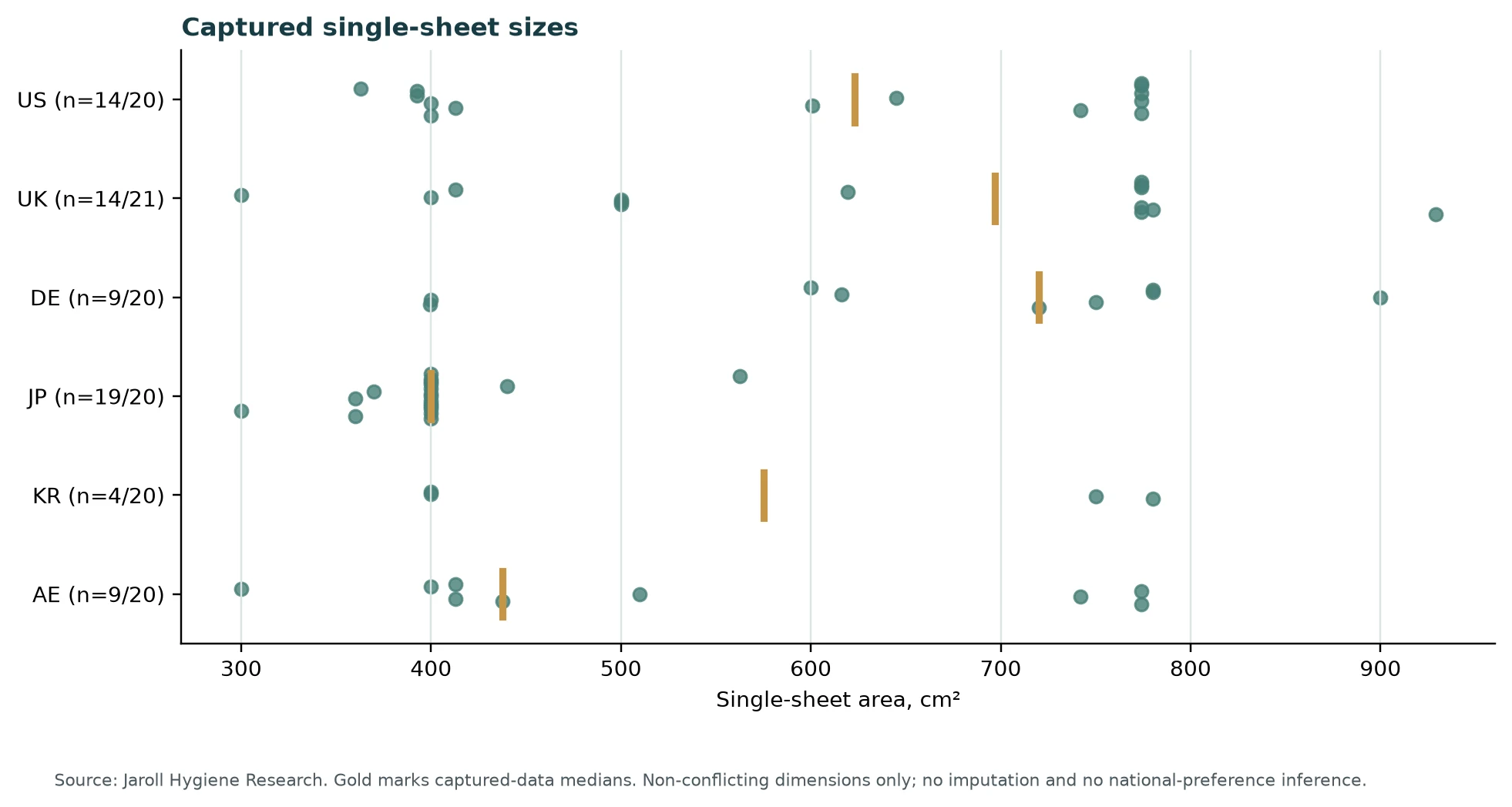
Captured median area runs from 400 cm² in Japan to 720 cm² in Germany, an 80% spread inside a category that retailers describe with the same three words. The brands and channels behind those numbers differ sharply, and the denominators range from 4 records to 19, so the ranking is a description of the sample. What survives is procedural: exact width and length in centimetres is the only form a quotation can be checked against. "XL" appeared on pages and never became a dimension in this dataset. Inches convert at 2.54 cm, and MOMENT's 200 × 200 mm becomes 20 × 20 cm; approximate conversions stay labelled as approximate.
3.5 Count: the pack is more standard than the sheet
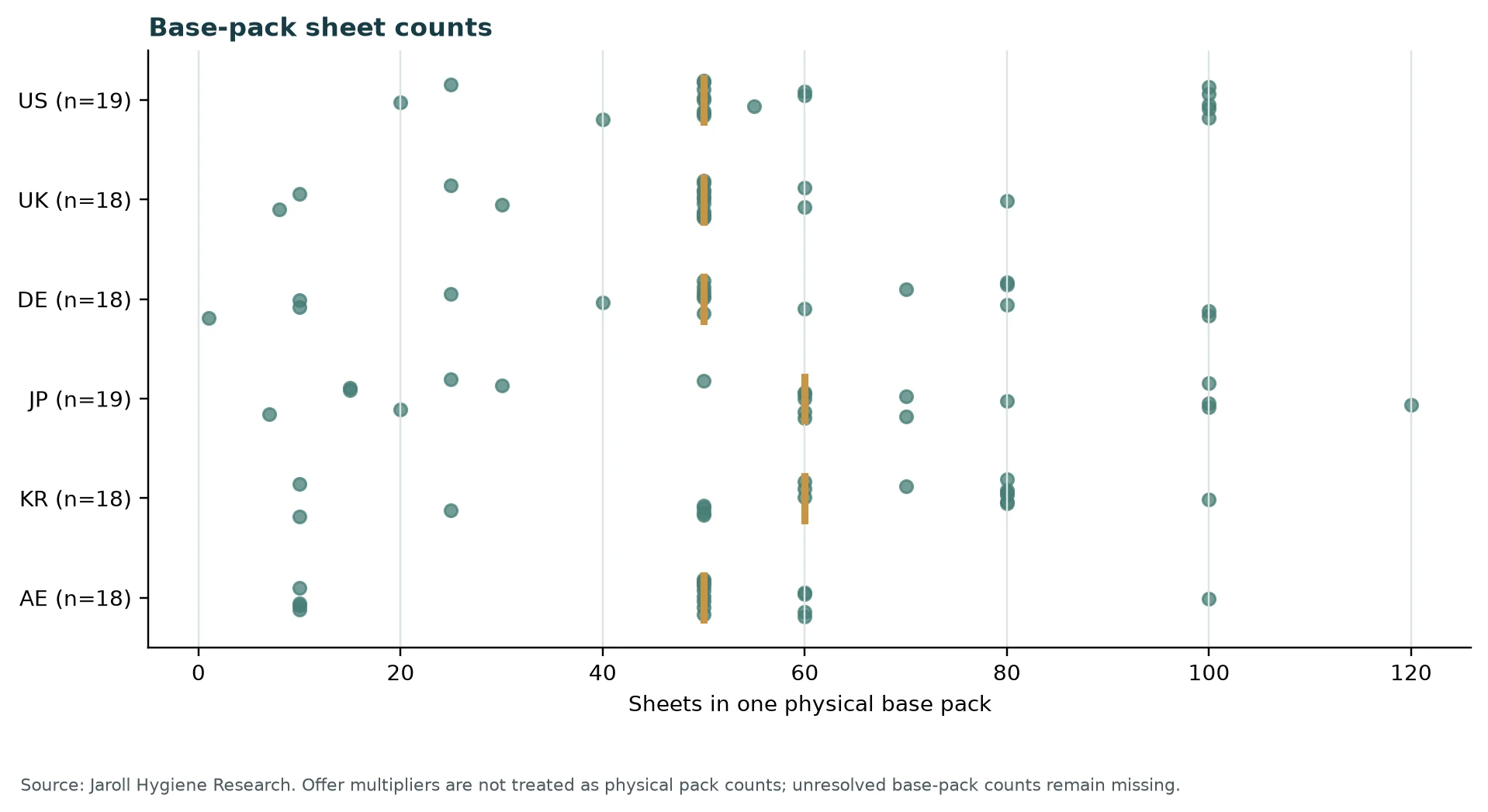
The median base format is 50 sheets in four markets and 60 in two. China's retail median is 80, the highest in the study. Compressed tablets, travel boxes and cube packs produce the low outliers, eight and seven sheets. The high end is where confusion starts: a multipack of 3 × 100 is one product format, not three SKUs, and its 300 sheets is an offer total rather than a pack count. Total sheets per offer reaches 800 in this panel, and any per-sheet price built on the wrong denominator inherits that error.
3.6 Packaging: five requirements hiding in one word
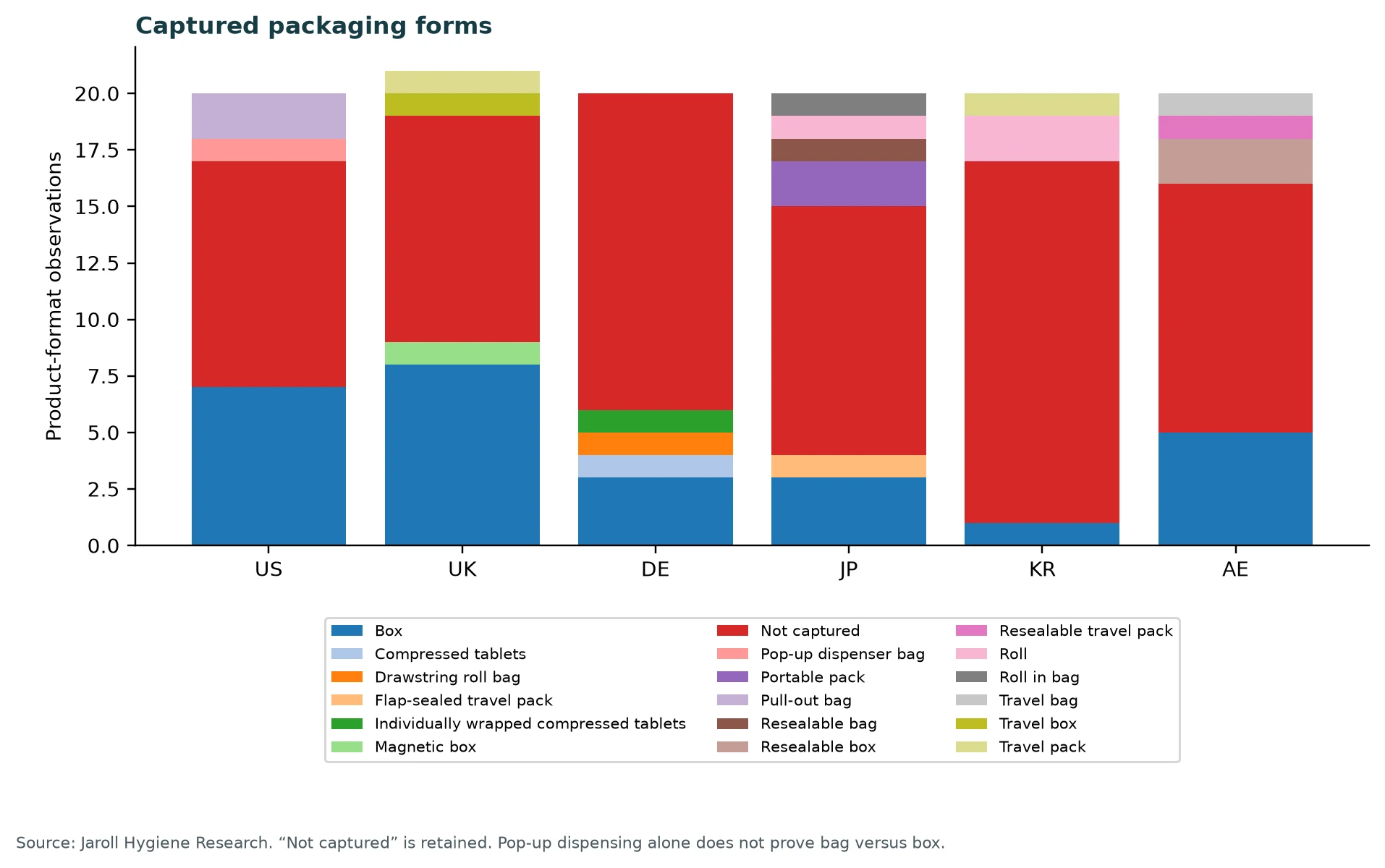
Forty-nine of 121 records describe a container at all. Of those, 31 are some kind of box, five are rolls, and the remainder are travel packs, hanging packs, pull-out bags and individually wrapped compressed tablets. Boxes dominate in the United Kingdom and the United States; Japan and Korea carry the roll formats; Germany is the only panel with compressed tablets in the capture.
Packaging is the least standardised commercial field we asked for, and the gap between what buyers mean and what pages say is wide. "Pop-up" describes a dispensing mode and does not prove a bag. A resealable box and a magnetic box are different objects with different cost. Buyers should state container, dispensing mode, closure, count and refill behaviour as five separate requirements.
4. Price: three denominators that disagree
Price per pack, price per sheet and price per unit area answer three different questions, and this panel is the reason to keep them apart. A one-base-pack price uses only a positive ordinary offer where one physical pack was bought and its count is known: multipacks, subscriptions, member prices, coupons, unresolved billing and shipping are excluded. Price per offered sheet divides a valid focal price by the verified total sheets in that offer, so multipacks enter. Price per 1,000 cm² divides the per-sheet price by captured sheet area, which is the only measure that puts a 400 cm² sheet and a 720 cm² sheet on the same footing.
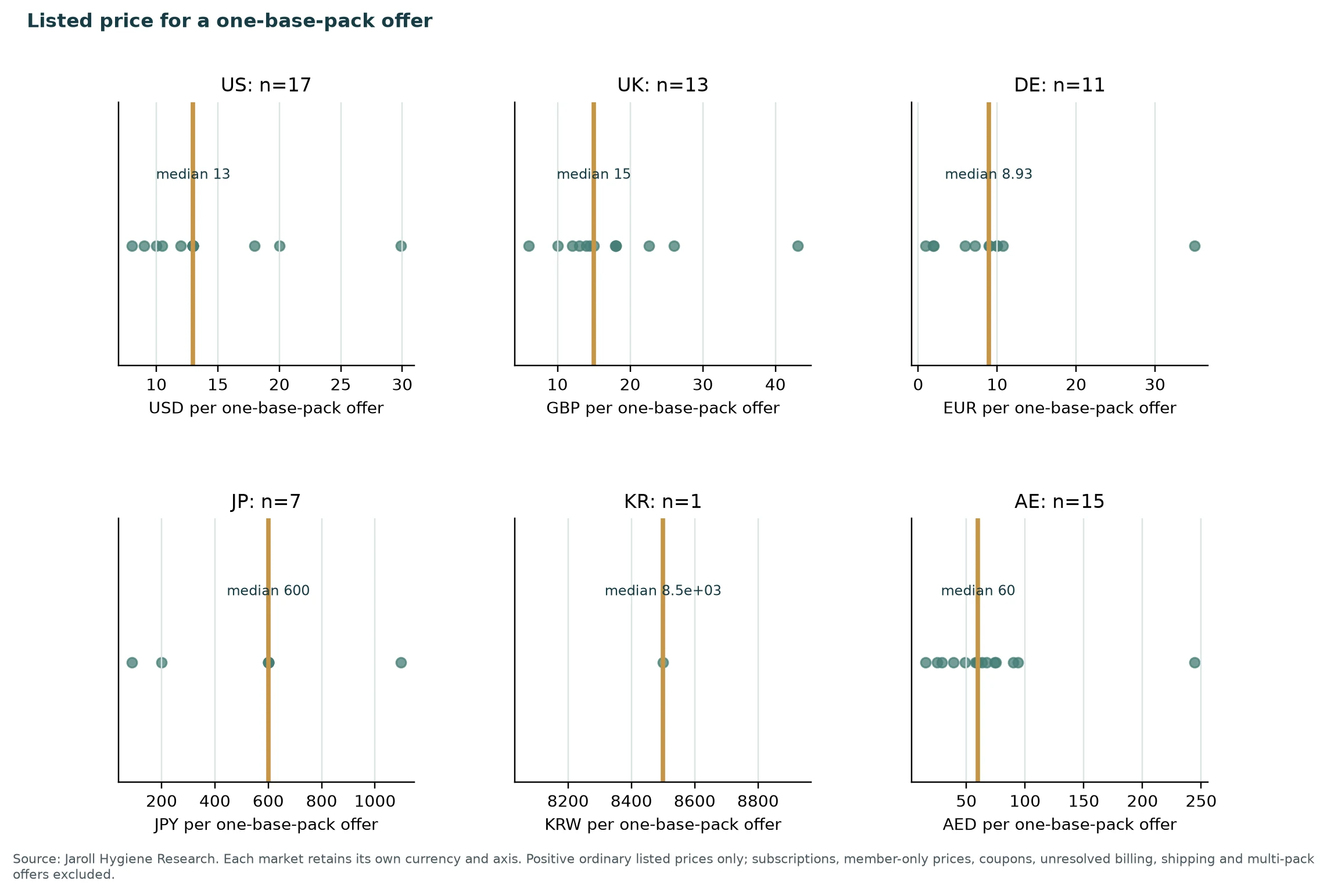
The one-pack denominator is thin almost everywhere and effectively absent in Korea, where one observation produces the 8,500 KRW median. Selected-sample medians are 12.99 USD, 15.00 GBP, 8.93 EUR, 600 JPY, 8,500 KRW and 60 AED. Read the Korean figure as one price, not a market level.
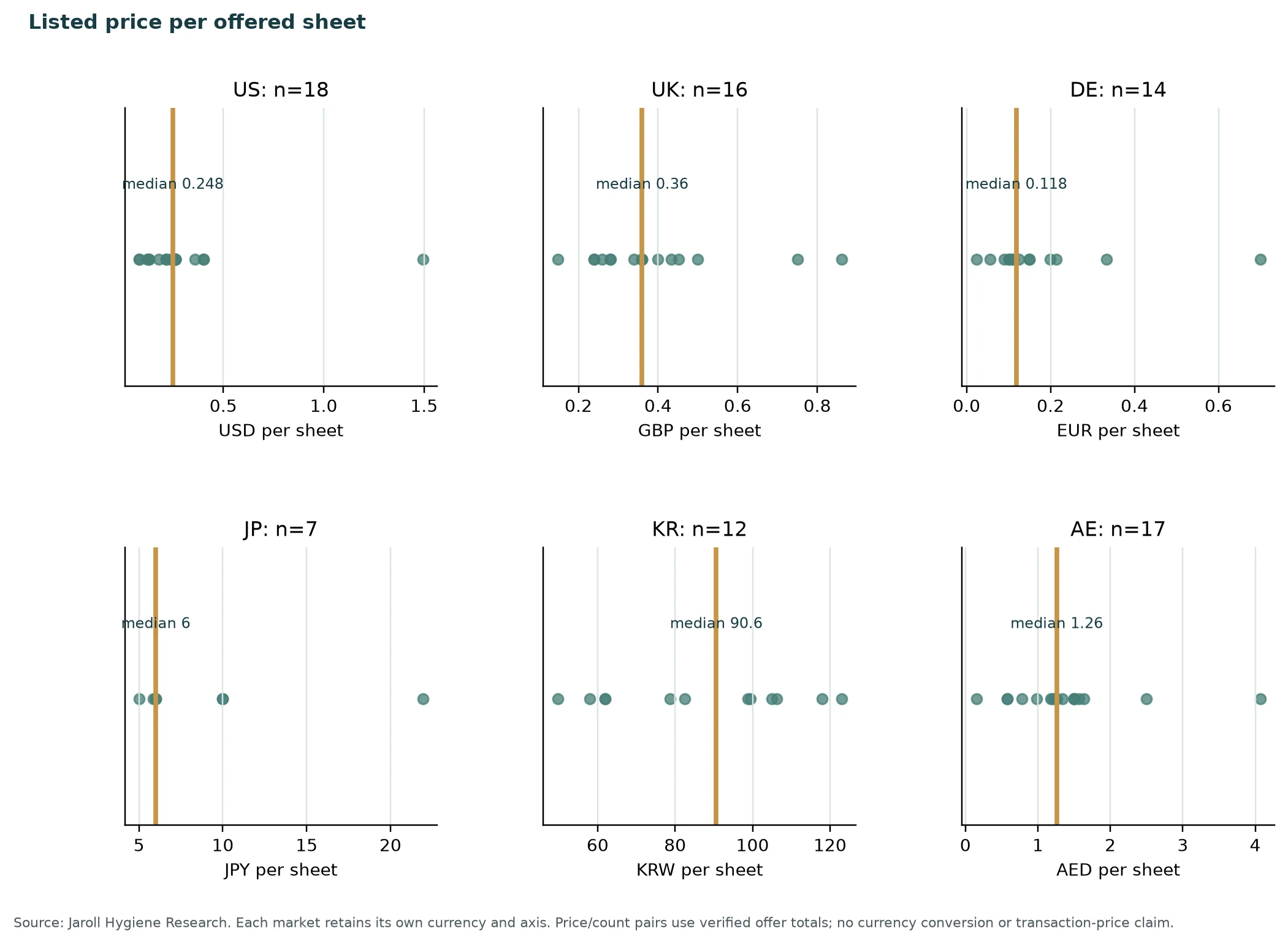
Per-sheet medians are 0.2480 USD, 0.3599 GBP, 0.1183 EUR, 6.0000 JPY, 90.6250 KRW and 1.2600 AED. They are not a global price ranking: currency, tax treatment, channel, sheet area, fiber, packaging and offer quantity all move at once. The German and UK figures happen to be the two that invite comparison in Europe, and the per-sheet gap between them is 3.0 times.
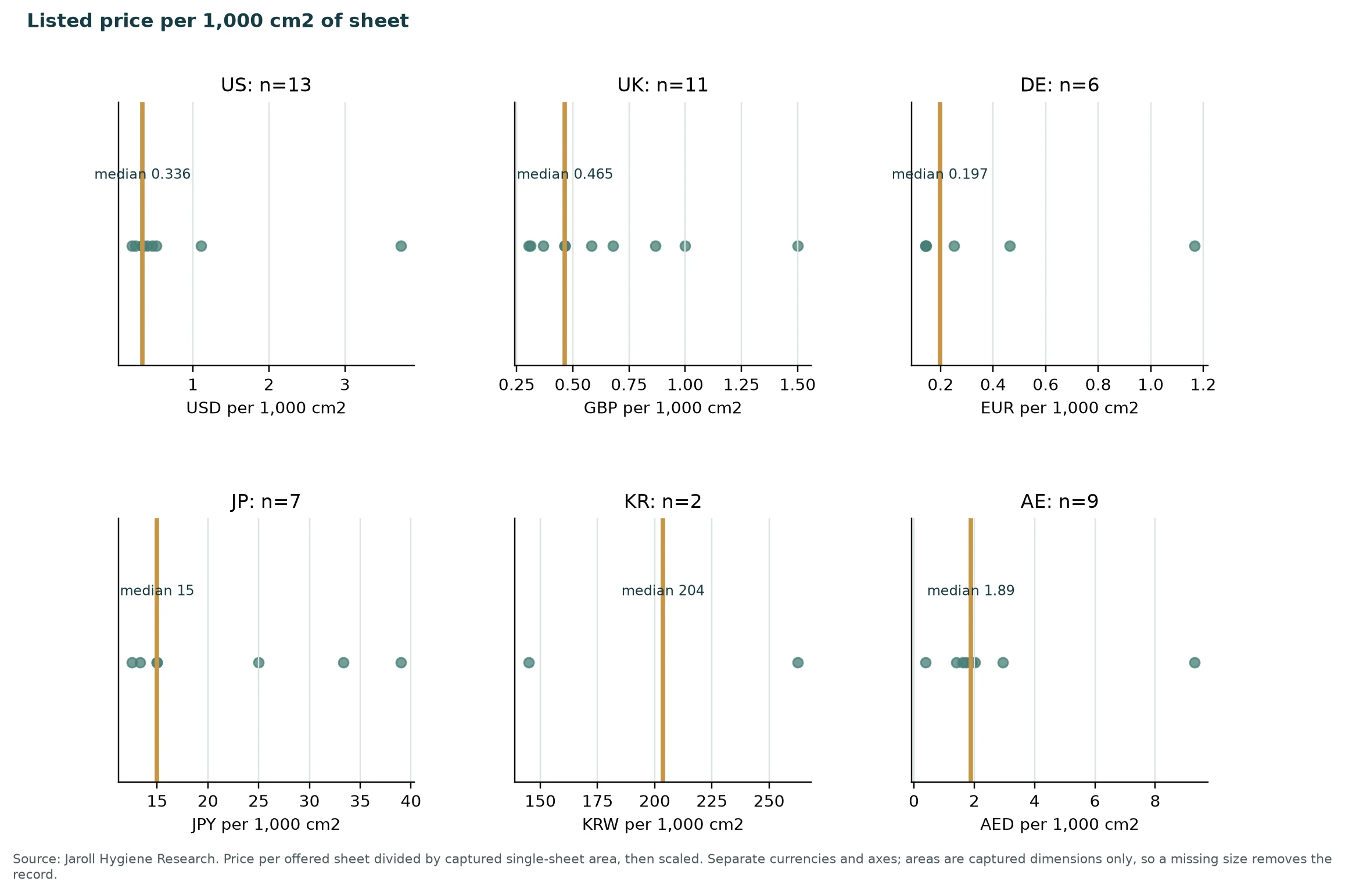
Normalise the same two markets by area and the gap falls to 2.4 times: EUR 0.197 against GBP 0.465 per 1,000 cm². Part of the UK premium is that its sheets are smaller, not that its material is dearer. Part of it is channel. Either way, the choice of denominator changes the size of the conclusion, which is why the denominator belongs in the quotation and not in the reader's assumptions.
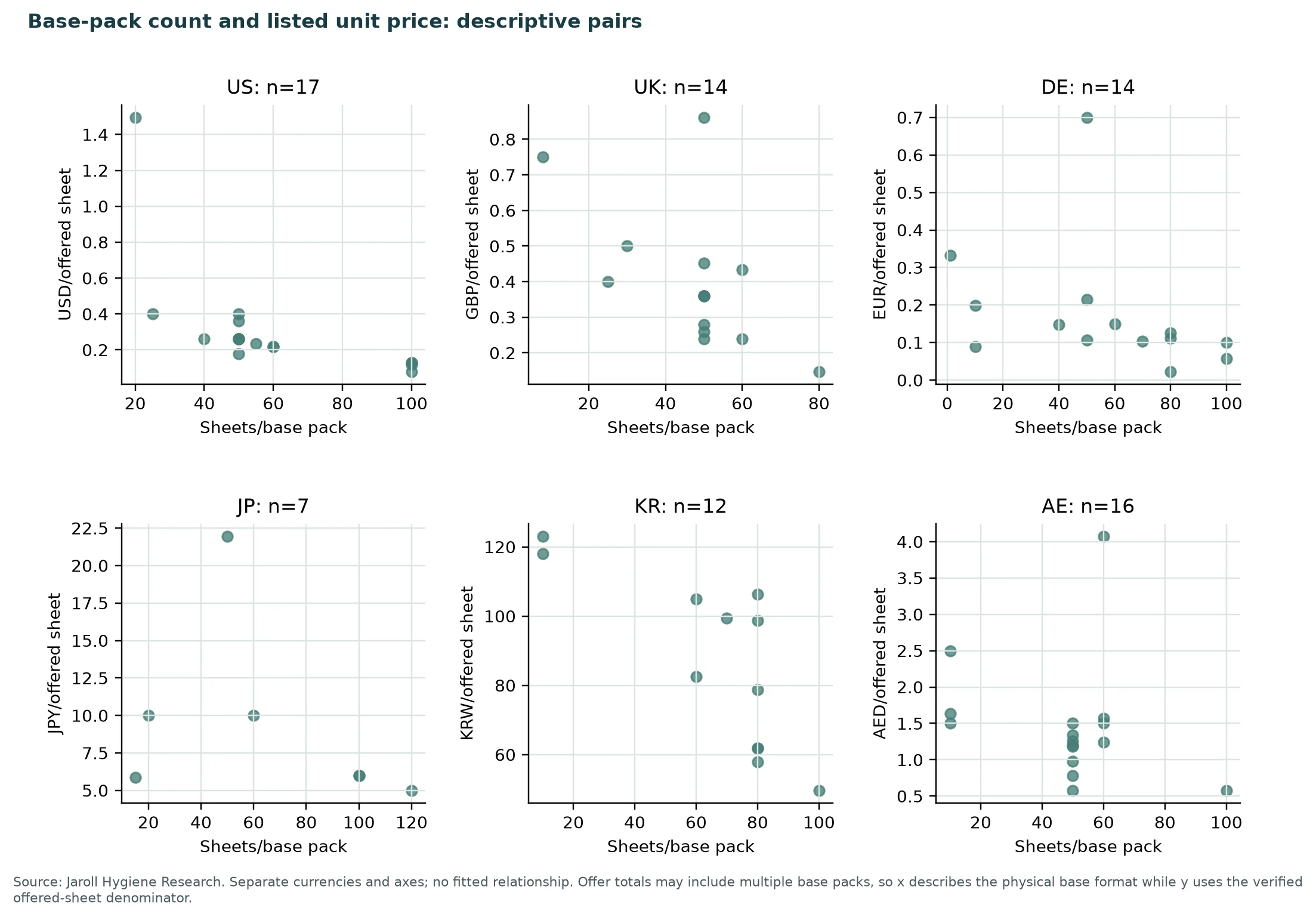
That pairing is a diagnostic for quotation review, not a demand curve. Unit price uses the full offer total while the horizontal axis describes one physical pack; brand, fiber, size, GSM, packaging and promotion are uncontrolled. It supports normalisation. It does not support the claim that larger packs carry a particular discount.
Channel is the last variable, and the cleanest demonstration of it sits in the UAE. Seventeen price pairs give a median of 1.26 AED per offered sheet. Eight of those pairs are purchase-agent offers that bundle duties and taxes into the displayed price. Remove them and nine pairs remain at 1.18 AED. A 7% swing, no product change, no currency change — only a decision about which offers belong in the denominator.
5. Demand and growth: what the published numbers actually cover
Sellers and buyers both quote category growth. The published evidence divides into two kinds that do not reconcile: association and government statistics on the substrate, and commercial forecasts on the finished product. This section reports each with its scope, and adopts neither.
5.1 The official series measure nonwovens, not facial towels
European nonwovens output was 2,919,000 tonnes in 2025, down 2.2% on a year that had itself recovered 2.6%. Inside that total, roll goods for personal care wipes rose 0.9% and hydroentangled material — the spunlace family that most facial towels use — rose 0.1%, while hygiene applications fell 2.7%. Those four figures come from one release and describe one year. Over five years the more important number is grammage: the European average fell from 37.2 gsm in 2019 to 34.9 gsm in 2024, a 6.2% reduction, and in 2024 surface area grew faster than tonnage, 2.9% against 2.6%. The industry is delivering more square metres from less weight, which is exactly what a thinner facial towel looks like from upstream.
China runs the other way on volume. Nonwovens output reached 8.561 million tonnes in 2024, up 5.1%, and spunlace alone reached 1.665 million tonnes, up 8.1%. Japan's domestic output fell to 256,991 tonnes in 2025, down 4.9% and 25.1% below its 2017 peak of 343,013 tonnes.
At product level only one audited number exists in this study: Winner Medical reported dry and wet cotton facial towel revenue of CNY 1.761 billion for 2025, up 13.05%, inside a consumer segment of CNY 5.75 billion that grew 15.2%. One company's category revenue is not a market growth rate. It is, however, the only figure in this report that counts the finished product rather than the web.
| Market | Indicator | Latest value | Year on year | Publisher |
|---|---|---|---|---|
| Greater Europe | Nonwovens output, all processes | 2,919,000 t | -2.2% | EDANA, April 2026 |
| Greater Europe | Roll goods for personal care wipes | volume not published | +0.9% | EDANA, April 2026 |
| Greater Europe | Hydroentangled output | volume not published | +0.1% | EDANA, April 2026 |
| Greater Europe | Average grammage, all nonwovens | 34.9 gsm (2019: 37.2) | -6.2% since 2019 | EDANA |
| China | Nonwovens output | 8.561 Mt | +5.1% | CNITA, 2024 |
| China | Spunlace output | 1.665 Mt | +8.1% | CNITA, 2024 |
| Japan | Domestic nonwovens output | 256,991 t | -4.9%, -25.1% since 2017 | METI production statistics |
| China, one company | Winner Medical, dry and wet cotton facial towels | CNY 1.761 bn | +13.05% | 2025 annual report |
| US, UK, Korea, UAE | No published category series for facial towels | — | — | — |
5.2 The commercial forecasts disagree by a factor of 4.7
Four forecasts of the same category label were reachable in this collection window. They agree on direction and on almost nothing else.
| Publisher | Base-year value | Forecast | Stated CAGR | Scope as published |
|---|---|---|---|---|
| Maia Research, February 2026 | USD 490.41 M (2025) | USD 1,067.55 M (2033) | 10.21% | Face towel only; roll extraction listed as the single product type |
| PW Consulting | USD 2.15 bn (2025) | USD 3.73 bn (2032) | 8.2% | Adds hotel, salon and household channels |
| Dataintelo | USD 2.31 bn (2025) | USD 4.37 bn (2034) | 7.2% | Cotton, nonwoven and bamboo; commercial and household |
| Verified Market Reports | country totals above USD 5.6 bn (2024) | per country, 2033 | 4.5–5.7% | Country by country; totals exceed every global figure above |
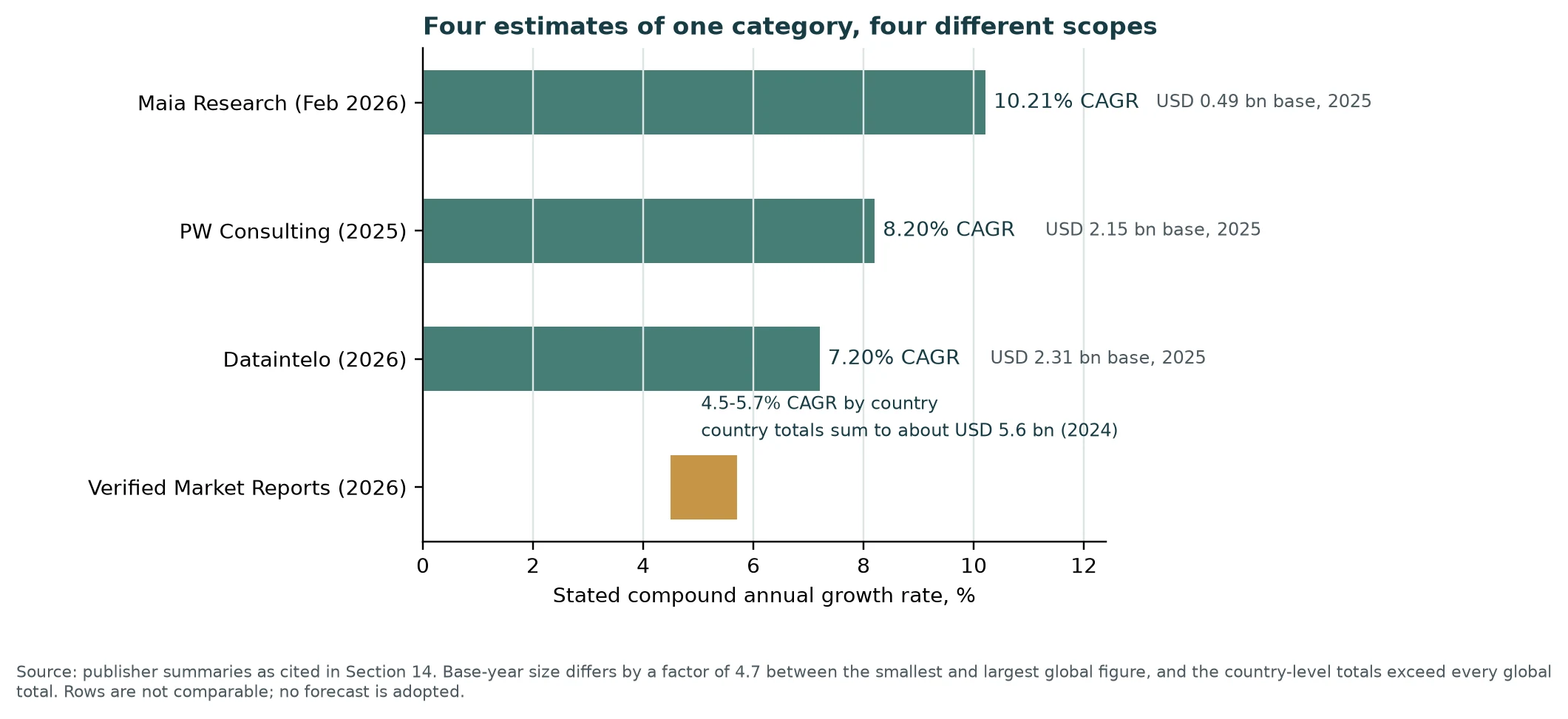
The largest base year is 4.7 times the smallest, and the CAGR range is 7.2% to 10.2% — a spread wider than the difference between a stagnant category and a fast-growing one. The fourth estimate cannot be reconciled even internally: its Asia Pacific figure of USD 2.5 billion for 2024 is smaller than its own China figure of USD 3.0 billion, and its four named countries already sum to about USD 5.6 billion, which is more than any other publisher's global total.
The lesson is not that the category is growing quickly. It is that published category size is scope-dependent, and a growth rate quoted without its scope is a number without a denominator. If a buyer needs a planning figure, the defensible move is to size the addressable niche from unit economics — packs per outlet per month times outlets — and to use these forecasts only as a direction check. Upstream, the one forecast with a published methodology puts global nonwovens at USD 88.55 billion by 2028 from USD 62.85 billion in 2024, a 7.1% annual increase by value. That is a substrate forecast, not a facial towel forecast.
5.3 What the regulatory calendar adds
Demand arguments in this category increasingly run through packaging rather than product. The EU packaging regulation begins phased application on August 12, 2026, and the UK ban on plastic wet wipes starts in England on May 19, 2027, with different dates in the other nations. Neither rule obliges a dry facial towel to change its web. Both change what a box, a bag and a printed claim may say. Section 10 sets out the dates and the distinctions that matter.
5.4 What this section does not establish
None of these series measures facial towels. A 2.2% fall in European nonwovens output is compatible with a growing facial-towel segment inside it, because hygiene, wipes, construction and automotive moved in different directions in the same year. A 4.9% fall in Japanese output is compatible with a stable Japanese retail category supplied increasingly from abroad. We report the substrate numbers because they are the only audited ones, and we decline to convert them into a category growth rate. No forecast in this section was adopted, averaged or smoothed.
6. Seven trends that the data supports
1. The web is getting lighter while the sheet holds its size. European average grammage fell from 37.2 to 34.9 gsm between 2019 and 2024, while surface area grew 2.9% against 2.6% for tonnage. Lighter web, same or larger sheet, and a lower material cost per square metre: that is the direction of travel upstream, and it is why GSM disclosure matters more than it used to.
2. Fiber labels are drifting toward regenerated cellulose and away from a stated ratio. Rayon or viscose is the largest resolved group in this panel at 39 of 121; cotton follows at 32; only 44 records give a percentage at all. Viscose, bamboo viscose and lyocell are chemically distinct and commercially interchangeable in a sentence, which is precisely the problem.
3. Formats are fragmenting faster than packs are standardising. Nineteen distinct container words appeared across 55 records: boxes, resealable boxes, magnetic boxes, travel boxes, rolls, roll bags, hanging packs, pull-out bags, pop-up bags and compressed tablets. Base-pack counts stayed in a narrow band of 50 to 60 while the containers around them multiplied.
4. The comparison unit is unstable, and it changes the answer. The UK-to-Germany per-sheet gap is 3.0 times and the per-area gap is 2.4 times. Neither is wrong; they answer different questions, and a buyer who does not name the denominator is comparing two different things.
5. Supply is shifting east while European and Japanese output contract. European nonwovens fell 2.2% in 2025, Japanese domestic output fell 4.9%, and Chinese output rose 5.1% with spunlace up 8.1%. The finished product follows the web, and the web is moving.
6. Regulation is moving from the product to the packaging. PPWR application begins in August 2026, the English wet-wipes ban in May 2027, and neither addresses the dry towel's fiber. The compliance cost lands on the box, the film and the printed environmental claim.
7. Channel sets the visible price more than the product does. The UAE median moves 7% when eight purchase-agent offers are excluded, from 1.26 to 1.18 AED per sheet, with no change to any physical specification.
The seventh trend is the one that most often goes unrecorded, because it lives in the denominator rather than on the page. The first six are visible to anyone who reads enough listings. All seven point the same way: the category is documented in adjectives and purchased on numbers, and the gap between the two is where money is lost.
7. How the data was collected
The unit of observation is a country-product specification tied to one physical consumer format. Bulk offers of the same base pack are collapsed into one record. A different travel container, sheet design or base count can remain a separate format. Renbe's 30-sheet box, 60-sheet box and 8-sheet travel box share a nominal sheet design, so the three records do not represent three independent material samples. Sold-out listings are retained when the specification is still legible, with the stock uncertainty kept on the record.
Selection was purposeful, not random. We followed relevance and permitted access, reading opened product text, model-matched manufacturer information, Product structured data and documented image alt text. Search-only leads, blocked pages, misdirected product IDs, reusable textiles, ordinary tissues, pre-wetted wipes and products with uncertain local destination were not promoted to fill a quota. The universe is not exhausted, and the source snapshots stay internal.
Two exclusions are worth recording because they show how easily a panel absorbs noise. A discovered Enblanc product ID returned wet wipes; the exact Pink Pop facial-towel page was verified separately. A German-language Beauty Bay URL delivered in GBP to the United Kingdom and was not counted as Germany. The English UK25CT page now names eucalyptus viscose, which updates UK03; that is field verification on a later date, not evidence that the material changed.
No login, purchase, message or access restriction was bypassed. Failed reads and redirects are saved. Supplementary direct HTML was used only after reviewing public access rules, and crawling stopped where a page was blocked. An earlier browser-automation pass returned no verified facts and was not retried.
Price rules are deliberately strict. A focal one-time offer price is divided by the verified offer total, never by a guessed base-pack count. Subscriptions, member and card discounts, coupons, best-offer negotiations, zero placeholders, related recommendations and unbound billing options are excluded. The Gmarket Kleenex seller price of 34,780 KRW is kept rather than the 32,700 KRW coupon price. Essential Glow's displayed price stays null because the ordinary purchase binding is unresolved. Taxes, shipping, stock and purchase-agent fees are not harmonised.
Single-sheet dimensions are kept separate from carton dimensions. Inches convert at 2.54 cm; MOMENT's 200 × 200 mm becomes 20 × 20 cm. US06's unresolved size conflict is excluded from size statistics. Item weight, a bare "80g", three-dimensional package measurements and count totals do not become GSM.
Fiber coding requires a generic fiber name. "Plant-based", "cellulose", "USDA biobased" and raw "bamboo" are not enough. Renbe names bamboo processed into viscose; WOWOTEX specifies rayon derived from bamboo. Rayon and viscose are grouped as seller wording without asserting that every rayon uses the viscose process, and lyocell stays separate. A biodegradability percentage is not a fiber ratio. Seller certification and clinical wording are recorded as unverified.
Packaging needs container evidence; "pop-up" describes a dispensing mode, not a box. "Solid" is a color or pattern attribute and is not coded as plain. The plain/pearl contradiction on UK10 remains unresolved. Smooth and textured dual surfaces are seller design descriptions, not measured embossing. We did not exhaustively inspect photographs or physical packaging.
Statistics are counts, valid denominators, medians and ranges. Sensitivity files keep the country-brand view and the single-pack view; one file supplies the same metrics with purchase agents and identified cross-border channels removed. The DE11 material conflict stays in the data. New ordinary-price exclusions cover iHerb cart prices, Costco membership pricing and an unresolved Bambuyu billing path. Evidence was accessed across October 12–18; older cache dates remain in the snapshots, so the final date is not a blanket price refresh. Storefront labels imply neither local inventory nor verified origin. We do not report shares, preference, causal fit, p-values or growth from this dataset. All eleven figures are generated offline from the saved data.
Section 5 is the only place where numbers from outside this dataset appear. They come from two industry associations, one government production statistic, one listed company's annual report and four commercial forecasts, each cited in Section 14 with its scope. None was recalculated here and none was selected to support a conclusion.
8. Material and manufacturing
The technical question is not "which fiber wins". It is how fiber wetting, pore structure, bonding and surface feel interact in a sheet that is used wet, on skin, once.
Chen and colleagues examined spunlaced viscose and polyester wound-dressing structures. Their abstract links mass per area, jet pressure and cross-lapping to pore structure, and describes different liquid-transfer behavior for hydrophilic and hydrophobic fibers. The application is wound dressings, the full paper was restricted, and none of it converts into a numeric facial-towel ranking. S11
Maiti, Bele and Basu studied hydroentangled polyester, viscose and blends against absorbency and tensile-related endpoints. The abstract establishes the design variables; we did not import numbers from results we could not inspect. Historical pulp/polyester patents show that such hydroentangled structures have been described for decades, but patent assertions are not independent validation of a towel sold today. S10 S12
| Material | Literature-grounded mechanism or observed label | Proposed comparison; no Jaroll test result |
|---|---|---|
| 100% Viscose | Viscose is hydrophilic; liquid uptake also depends on pore geometry and process | Measure uptake time and capacity separately; wet tensile, surface shedding and softness require matched sheets |
| Viscose / Polyester | Mixing wetting characteristics and changing web structure can alter transport | Lock blend percentages, denier, length, finish, orientation and measured GSM before comparing wet strength or feel |
| Wood Pulp / Polyester | Hydroentangled pulp with longer synthetic reinforcing fibers is an established process concept | Test the strength, absorbency and shedding balance for the actual recipe; do not equate retail pulp/rayon with this blend |
| Cotton | 32 international records explicitly label cotton; labels do not prove processing or certification | Control preparation, fiber quality, web bonding and finishes; do not rank cotton by the product name alone |
| Generic cellulose, plant or bio-based | These descriptions do not resolve exact fiber species or ratios | Obtain a composition declaration before choosing a material test or environmental claim |
No fiber wins across absorption, wet strength, softness, lint and cost at the same time. The explanations we propose for strength reinforcement, hand feel, packaging bulk and shedding are hypotheses for a matched test matrix, not findings. The retail data contains seller claims and no independently measured performance dataset.
Three environmental terms get used as if they were one. Plant origin describes feedstock. Biodegradation describes behavior under defined conditions. Compostability adds a specified composting system, timeframe, disintegration and other conditions. Superiority needs a stated comparison and evidence; it does not follow from a plant name. A towel containing polyester is not an entirely plant-fiber towel. A claim about the towel body also says nothing about the box, bag, ink, adhesive or label. FTC guidance supports careful qualification and substantiation, and this report certifies no sampled product. S13
Two retail pages show why wording needs checking before it becomes a specification. The Mysa page carries a polyester/cotton material attribute while its description refers to plant fiber cotton and pure plant materials; its pattern attribute says plain while the description says pearl. Both conflicts stay unresolved in UK10. That is a clarification need, not evidence of an unsafe product or an intentional misrepresentation. ForPro pages name 100% viscose and also display a cotton-protocol statement; the material wording is retained and the certification's applicability remains unverified.
9. GSM and what it does not tell you
For a rectangular sheet, theoretical mass in grams is width in metres × length in metres × GSM. At 20 × 20 cm, the 50 to 100 GSM sequence gives 2.0, 2.4, 2.8, 3.2, 3.6 and 4.0 g. At 20 × 30 cm it gives 3.0, 3.6, 4.2, 4.8, 5.4 and 6.0 g. These are calculated dry-web masses, not weighed finished sheets.
The formula has a counterintuitive consequence, and it is the single most useful calculation in this report. A 25.4 × 30.48 cm sheet at 50 GSM carries 3.871 g of web, more than a 20 × 20 cm sheet at 80 GSM at 3.2 g. Comparing GSM alone can therefore reverse which sheet uses more material. Moisture, finishes, cutting tolerance and measured basis-weight variation sit outside this calculation.
Cost behaves the same way. Holding size, recipe, web price per kilogram and yield constant, moving from 80 to 100 GSM raises material consumption by 25%. For 1,000 sheets at 20 × 20 cm, theoretical net web consumption rises from 3.2 kg to 4.0 kg. Factory cost also includes cutting and converting, packaging allocated per sheet, labour and energy, quality control, fixed-cost allocation and actual scrap. The public identity is C_material = sheet_area_m² × GSM / 1000 × web_price_per_kg / yield. No confidential Jaroll price, yield, customer quote or margin appears in this report.
Thickness and bulk depend on apparent density and measurement pressure. Absorption capacity per gram and capacity per sheet answer different questions, and uptake speed is a third. Wet tensile depends on fiber properties, entanglement, direction and preparation. Softness, wet abrasion and lint do not follow a monotonic curve from GSM. A heavier sheet may suit a task; it is not automatically softer, stronger or cleaner. S11
The theoretical-mass combinations are in theoretical_mass.csv. They are formula outputs, not an additional figure.
The laboratory package contains a 54-cell planning register, staged sample selection, independent-batch replication, conditioning and instrument records, blank result templates and descriptive plotting code. No cell is marked available or tested. Method texts and a qualified laboratory's SOP have to be obtained before any conformity claim or result release.
10. Standards, testing and the regulatory calendar
SAMR's record identifies GB/T 40276-2021, Soft nonwoven towels, as the current recommended Chinese national standard. It was published on May 21, 2021 and took effect on December 1, 2021. The record lists 青岛佳柔卫生用品有限公司 among the drafting units and 田贺 among the principal drafters. Drafting participation is professional background; it is not a government certification of every Jaroll product, and no government or standards-body mark appears in this report. S1
The standard-book catalogue describes dry nonwoven wiping towels made from textile fibers for cleaning human skin, plus a framework covering requirements, test methods, inspection, labeling and packaging, transport and storage. We use that public scope summary and do not reproduce clause thresholds from a full text we did not inspect. GB 15979-2024 is a separate current mandatory hygiene standard, effective July 1, 2025. A laboratory has to determine the applicable product class and current requirements rather than carry forward an old edition by habit. S2 S3
The method candidates are ISO 9073-1:2023 for mass per area; ISO 9073-2:1995 and its corrigendum for thickness; ISO 9073-3:2023 for strip tensile and elongation; ISO 9073-6:2025 for absorption; ISO 9073-10:2003 for dry lint and particle generation; and ISO 139:2005 with its amendment for conditioning. The absorption edition changed in 2025, which matters to anyone reusing an old protocol. A dry lint method is not a wet-rubbing lint method, and a listed method does not prove that a product was tested or passed. S4 S5 S6 S7 S8 S9
No one-to-one facial-towel standard was demonstrated across these markets. EU consumer-product safety and packaging rules are separate from nonwoven performance tests. PPWR begins phased application on August 12, 2026, and each packaging duty and transition has to be checked on its own. Its food-contact PFAS provisions are not a blanket rule for dry facial towels. The EU sustainable-consumption measures apply from September 27, 2026, with national implementation and transition still to review. S21 S14 S15
EU single-use-plastic guidance defines the relevant wipe category as pre-wetted personal-care or domestic wipes. England's ban on plastic wet wipes starts on May 19, 2027, and the other UK nations have different dates. A dry face towel does not acquire a pre-wetted-wipe obligation because a user might add water. That distinction removes nothing else: safety, labeling, chemical and packaging duties still apply. S16 S17
Product classification, required labels, importer duties and claim-specific rules in Japan, Korea and the UAE were not audited SKU by SKU. No sampled product is declared compliant. Sterile, antimicrobial, medical, sensitive-skin, acne, biodegradability and compostability statements each need evidence tied to the claim, the finished product and the destination.
The most defensible dated signal for product development is the manufacturer announcement. Unicharm announced a Silcot facial towel in April 2023 and an additive-free extension in March 2024; Yuhan-Kimberly announced two Kleenex cotton face-towel products in August 2026 and described two-way pop-up packaging. Those announcements establish that large manufacturers added formats and worked on dispensing. They do not establish the size or growth rate of the category, and we did not adopt the third-party forecast quoted inside the Korean release. S18 S19 S20
11. What a buyer should put in the RFQ
Start from the task, not the product name: drying after cleansing, wet makeup removal, treatment-room wiping, or travel. Then ask for the six fields this study found missing, in this order.
1. Fiber by percentage, not by adjective. "Viscose" is a start; "100% viscose, 45 g/m²" is a specification.
2. Width and length in centimetres, with a tolerance. Not "XL", not a product name that implies a size.
3. Measured GSM with a tolerance, and the method that produced it. If the supplier cannot name a method, the number is a label.
4. Texture by sample or photograph, referenced to a specimen number. Trade names travel badly between factories.
5. Base-pack count and offer quantity as two separate numbers. A multipack of 3 × 100 is not 300 in one pack.
6. Container, dispensing mode, closure and refill behaviour, stated separately. "Pop-up" answers one of the four.
Then state the price basis: per pack, per sheet or per 1,000 cm², ex-works or delivered, taxes included or not. A quotation that leaves the denominator implicit cannot be compared with anything, which is why the denominators in Section 4 disagree by 2.4 to 3.0 times on the same two markets.
Test by task, not by the largest GSM number on the table. Compare capacity per sheet and per gram, uptake time, machine- and cross-direction wet tensile, the lint condition that matches use, and hand feel under one procedure.
Environmental copy needs the same discipline. State the fiber composition precisely, identify whether the claim covers the towel body or the packaging, name the disposal environment, and keep the supporting report. Traceability runs from the agreed specification to the approved sample, the production lot and the released documentation. A claim can only be as broad as its evidence.
12. Limitations
This is manufacturer-sponsored desk research on 121 selected international observations and 11 separately sampled China records. All six numerical targets were met without producing a census. No additional European or Middle Eastern market was sampled, and brand, channel and product-family concentration persists. Japan's 20 observations come from four brands, and several are the same sheet design in a different box.
There was no physical inspection, factory measurement, consumer survey, interview, private cost data, complete market-size series or SKU-level legal audit. Literature from other applications and catalogue metadata cannot establish a facial-towel performance ranking. Authorized standard texts and laboratory SOPs are required before any test or conformity claim.
Retailer summaries, source age, generic descriptions, packaging labels, unharmonised tax differences, price conditions and sold-out status all limit comparison. The cross-border exclusion is a sensitivity view over a changed product mix, not a causal estimate. Missing and conflicting data are not imputed. Environmental, clinical, certification and production-origin claims remain unverified.
Section 5 carries a limitation of its own. Three of its five sources are forecasts, and the four commercial estimates cannot be reconciled with each other: base-year size differs by a factor of 4.7, one publisher's country totals exceed another's global total, and one contains an internal contradiction between its regional and national values. The official series measure nonwovens, not facial towels. No growth rate in this report should be quoted without the scope sentence that accompanies it.
13. Conclusions
1. The category is sold in adjectives and bought in numbers. GSM on 4 of 121 international records, a full fiber ratio on 44, a texture statement on 37. Those three counts are the most useful thing in this report, because they tell a buyer exactly which questions will go unanswered.
2. Regional difference is real but narrower than the retail language suggests. Sheet area spans 400 to 720 cm², pack counts cluster at 50 and 60, and unit prices differ by 3.0 times before area normalisation and 2.4 times after. What differs most between markets is not the product but the disclosure habit: 19 of 20 records in Japan name a fiber, against 11 of 20 in Germany and the UAE and 12 of 21 in the United Kingdom.
3. Every derived number has a denominator, and the denominator is a choice. Per pack, per sheet and per 1,000 cm² give three different pictures of the same two markets. Channel decisions move a national median by 7%. Raw material origin is not fiber identity; an offer total is not a pack count; a displayed discount is not an ordinary purchase price.
4. Growth claims in this category outrun their evidence. The substrate data is audited and points east; the product-level forecasts are unaudited and disagree by a factor of 4.7. A direction can be defended. A number cannot.
5. The next step that would change these conclusions is a matched laboratory comparison on identical sheet geometry, composition and conditioning, covering absorption, wet tensile in both directions, lint and hand feel. Until that exists, the tables here are a way to write a better RFQ, not a way to rank products.
6. Nothing in this report certifies a product, a supplier or a compliance status. It documents what 132 pages declare, what they omit, and how much the answer moves when a denominator changes.
14. References
Contextual references retain their checked dates and access levels. Product URLs, field locators and collection dates are stored in the raw and cleaned data and in the source register. Public source discovery is not a fully screened sampling frame.
S1. SAMR/SAC: GB/T 40276-2021, Soft nonwoven towels. Official record opened. Evidence boundary: Current recommended standard; dates; Chinese drafter and drafting-unit entries.
S2. Authorized standard-book retailer: GB/T 40276-2021 scope summary. Publisher-associated public catalogue summary opened; full standard not acquired. Evidence boundary: Scope and technical framework summary; no clause thresholds transcribed.
S3. SAMR/SAC: GB 15979-2024, disposable sanitary products hygiene requirements. Official metadata opened. Evidence boundary: Current mandatory standard; effective July 1, 2025; applicability requires full-text check.
S4. ISO 9073-1:2023, determination of mass per unit area. Official catalogue metadata checked; authorized full text required for testing. Evidence boundary: Candidate test method identity and publication version.
S5. ISO 9073-2:1995, determination of thickness. Official catalogue indexed metadata; no detailed procedure used. Evidence boundary: Thickness method candidate; applicable corrigendum requires lab review.
S6. ISO 9073-3:2023, tensile strength and elongation, strip method. Official catalogue indexed metadata; no detailed procedure used. Evidence boundary: Current strip tensile method candidate.
S7. ISO 9073-6:2025, absorption; BSI catalogue corroboration. Official standards catalogues checked; full-text method not reproduced. Evidence boundary: 2025 absorption edition; supersedes 2000 edition.
S8. ISO 9073-10:2003, dry lint and particle generation. Official catalogue metadata checked; full-text method not reproduced. Evidence boundary: Dry-state lint method; catalogue says confirmed in 2025.
S9. ISO 139:2005, conditioning and testing atmospheres. Official catalogue indexed metadata only. Evidence boundary: Conditioning reference identity; actual SOP and amendment must be confirmed.
S10. Maiti, Bele and Basu: Effect of material properties and process parameters on properties of hydroentangled nonwoven fabrics (2021), DOI 10.1080/00405000.2020.1791398. Publisher indexed abstract; direct full-text read unavailable; bibliographic reference corroborated in S11. Evidence boundary: Study examined polyester/viscose, hydroentanglement and absorbency/tensile endpoints; no numerical findings imported.
S11. Chen, Deng, Wang and Gao: Investigation of moisture transfer properties of viscose and polyester fibers in spunlaced nonwoven wound dressings; online August 9, 2025; DOI 10.1177/00405175251345142. Publisher abstract opened; Crossref metadata saved; full article restricted. Evidence boundary: Fiber wetting and pore-structure interactions; dressing context prevents direct facial-towel performance inference.
S12. EP0326771B1: Highly absorbent nonwoven fabric. Published patent opened; used as process background only. Evidence boundary: Historical disclosure of hydroentangled pulp/polyester structures; patent claims are not independent product proof.
S13. FTC: Environmental Claims, Summary of the Green Guides. Regulator guidance opened. Evidence boundary: Environmental claims require appropriate support and disposal qualifications.
S14. European Commission: New EU packaging rules start to apply, August 11, 2026. Official dated announcement opened. Evidence boundary: PPWR begins phased application August 12, 2026; do not apply every future duty immediately or food-contact limits to all towels.
S15. European Commission: Sustainable consumption actions, Directive (EU) 2024/825 transition. Official indexed page; national implementation not audited. Evidence boundary: Application date September 27, 2026; national implementation and transition matter.
S16. European Commission: SUP marking specifications. Official public page opened. Evidence boundary: Wipe category refers to pre-wetted personal-care/domestic wipes.
S17. DEFRA: Plastic wet wipes ban. Current government guidance opened. Evidence boundary: England start date May 19, 2027; different UK-nation dates; dry/pre-wetted distinction.
S18. Unicharm: Silcot facial towel launch, April 14, 2023. Manufacturer historical announcement opened. Evidence boundary: Dated product introduction; not category growth or market share.
S19. Unicharm: Additive-free facial towel variant, March 5, 2024. Manufacturer historical announcement opened. Evidence boundary: Dated product-line extension; no quantitative adoption claim.
S20. Yuhan-Kimberly: Two Kleenex cotton face towels launched, August 4, 2026. Manufacturer announcement opened; not included in retail SKU denominator. Evidence boundary: Two named products and two-way pop-up packaging; cited third-party market forecast excluded.
S21. EUR-Lex: Regulation (EU) 2023/988, General Product Safety Regulation. Official indexed consolidated legal source; SKU compliance not audited. Evidence boundary: Consumer-product safety framework; duties depend on product/actor and current consolidated text.
S22. Jaroll About and technical/company context. Company-controlled page opened; self-reported, not an independent test. Evidence boundary: Manufacturer identity and declared manufacturing context; website confirmed by project configuration.
S23. EDANA: 2025 nonwoven production in Greater Europe, April 7, 2026. Association press release opened. Evidence boundary: 2,919,000 t total, -2.2%; personal care wipes roll goods +0.9%; hydroentanglement +0.1%; hygiene -2.7% in 2025. Substrate statistics, not finished facial towels.
S24. TexData International: Global nonwovens markets, summary of EDANA 2024 statistics. Trade-press summary of the association release; primary figures are EDANA's. Evidence boundary: 2.98 Mt and 85.1 billion m² in 2024, +2.6%; average grammage 34.9 gsm against 37.2 gsm in 2019; surface area growth outpacing tonnage.
S25. CNITA: 2024 China industrial textiles industry analysis. Association statistical report opened. Evidence boundary: Nonwovens output 8.561 Mt, +5.1%; spunlace output 1.665 Mt, +8.1%; medical and hygiene textiles fiber consumption 3.596 Mt, +3.1%.
S26. METI production statistics for nonwovens, 2025, as tabulated by Nonwovens Industry. Government statistic accessed through a trade-press tabulation; primary source is 経済産業省 生産動態統計. Evidence boundary: Domestic output 256,991 t in 2025, -4.9%; 343,013 t in 2017; overseas output by Japanese manufacturers reported separately.
S27. Winner Medical (300888) 2025 annual report summary. Company disclosure through a designated reporting channel. Evidence boundary: Dry and wet cotton facial towel revenue CNY 1.761 bn, +13.05%; consumer segment CNY 5.75 bn, +15.2%. Separately, and in the medical segment rather than the consumer one, overseas revenue was CNY 2.85 bn, +47.9%. One company's category revenue, not a market rate.
S28. Smithers: Strong growth for global nonwovens market, October 2023. Publisher summary of The Future of Global Nonwoven Markets to 2029. Evidence boundary: 15.15 Mt and USD 62.85 bn in 2024 rising to 21.29 Mt and USD 88.55 bn in 2028, +7.1% CAGR by value at constant prices. Forecast for the substrate.
S29. Maia Research: Global Disposable Facial Towel Industry Trends Analysis Report 2025–2033, February 2026. Publisher abstract opened. Evidence boundary: USD 490.41 M in 2025 to USD 1,067.55 M in 2033, 10.21% CAGR; roll extraction listed as the single product type. Forecast, scope not independently verified.
S30. Dataintelo: Disposable Facial Towel Market 2025–2034. Publisher summary opened. Evidence boundary: USD 2.31 bn in 2025 to USD 4.37 bn in 2034, 7.2% CAGR. Forecast, scope not independently verified.
S31. PW Consulting: Disposable Face Towel Market. Publisher summary opened. Evidence boundary: USD 2.15 bn in 2025 to USD 3.73 bn in 2032, 8.2% CAGR. Forecast, scope not independently verified.
S32. Verified Market Reports: Global Disposable Facial Towel Market 2026–2034. Publisher summary opened. Evidence boundary: Country-level values and 4.5–5.7% CAGRs; its Asia Pacific value of USD 2.5 bn for 2024 is smaller than its own China value of USD 3.0 bn, which rules it out as a reconciled source.
15. Data Appendix
International N=121; China retail 7/catalogue 4 remain separately tagged. Missing base counts and verified offer totals are distinct. Listed price does not prove stock. Reproduce with analyze_v4.py plus build_focus_charts_v4.py and the saved JSON. Core files: international-retail.csv, china-comparison.csv, sku_cleaned.csv/json, summary.json, channel-sensitivity.json, brand_sensitivity.csv, single-pack-sensitivity.json and theoretical_mass.csv. Lab remains NOT_CONDUCTED.
| ID / market | Brand / product | Sheet size | Base count / offer total | Listed offer price | Source |
|---|---|---|---|---|---|
| US01 / US | Clean Skin Club - Original XL, 50 towels | 10 × 12 in | 50 / 50 | 20 USD | Product source |
| US02 / US | Clean Skin Club - Bamboo XL, 50 towels | 10 × 12 in | 50 / 50 | 18 USD | Product source |
| US03 / US | Clean Skin Club - Clean Towels 25 Count | 7.5 × 7.5 in | 25 / 25 | 10 USD | Product source |
| US04 / US | Ourmed Life - Dot Pattern, 100 Count | 7.8 × 7.8 in | 100 / 100 | 12.99 USD | Product source |
| US05 / US | Ourmed Life - XL Boxed, 50 Count | 10 × 12 in | 50 / 50 | 12.99 USD | Product source |
| US06 / US | Ourmed Life - L Boxed, 60 Count | Not captured | 60 / 60 | 12.99 USD | Product source |
| US07 / US | Ourmed Life - EF Texture, 100 Count | 7.8 × 7.8 in | 100 / 100 | 12.99 USD | Product source |
| US08 / US | Ourmed Life - Square Boxed, 60 Count | 10 × 10 in | 60 / 60 | 12.99 USD | Product source |
| US09 / US | Ditoi - Disposable Face Towels, 50 Count | 10 × 12 in | 50 / 50 | 12.99 USD | Product source |
| US10 / US | Cliganic - Clean Face Towels, 50 Count | Not captured | 50 / 50 | 12.99 USD | Product source |
| US11 / US | enjoy cotton - 65 GSM EF facial towel, 20 Count | 20 × 20 cm | 20 / 20 | 29.89 USD | Product source |
| UK01 / UK | Clean Skin Club - Original XL, 50 towels | 10 × 12 in | 50 / 50 | 18 GBP | Product source |
| UK02 / UK | Clean Skin Club - XL Supreme, 50 towels | 10 × 12 in | 50 / 50 | 18 GBP | Product source |
| UK03 / UK | Clean Skin Club - Clean Towels 25CT | Not captured | 25 / 25 | 10 GBP | Product source |
| UK04 / UK | ISOCLEAN - Makeup Remover Dry Towels, 60 | Not captured | 60 / 60 | 14.4 GBP | Product source |
| DE01 / DE | Clean Skin Club - Clean Towels XL | Not captured | - / - | 18 EUR | Product source |
| DE02 / DE | Vanulo - Clean Face Towels XL, 50 | 20 × 30 cm | 50 / 50 | 34.99 EUR | Product source |
| DE03 / DE | PHLOV - FACE TOWELS, 80 | Not captured | 80 / 80 | 10 EUR | Product source |
| DE04 / DE | Scrummi - Normal facial towels, 80 | Not captured | 80 / 80 | 8.93 EUR | Product source |
| DE05 / DE | Scrummi - XL facial towels, 50 | Not captured | 50 / 50 | 10.71 EUR | Product source |
| JP01 / JP | ITO - Cleansing Towel BOX, 25 | 20 × 20 cm | 25 / 25 | Not captured | Product source |
| JP02 / JP | ITO - Cleansing Towel cube, 50 | 22.5 × 25 cm | 50 / 50 | 1097 JPY | Product source |
| JP03 / JP | ITO - Cleansing Towel roll, 250 g | 20 × 20 cm | - / - | Not captured | Product source |
| JP04 / JP | ITO - Skin Cotton Towel 100, 100 sheets | 20 × 20 cm | 100 / 100 | Not captured | Product source |
| JP05 / JP | ITO - Skin Cotton Towel 100, 30 sheets | 20 × 20 cm | 30 / 30 | Not captured | Product source |
| JP06 / JP | ITO - Portable cleansing towel, 15 | 22 × 20 cm | 15 / 15 | 88 JPY | Product source |
| JP07 / JP | ITO - Disposable handkerchief, 15 | 20.5 × 19.5 cm | 15 / 15 | Not captured | Product source |
| JP08 / JP | ITO - Facial Towel EF, 60 | 20 × 18.5 cm | 60 / 60 | Not captured | Product source |
| JP09 / JP | ITO - Facial Towel, 60 | 20 × 20 cm | 60 / 60 | Not captured | Product source |
| JP10 / JP | IRIS OHYAMA - TSC-70B, 70 sheets | 20 × 20 cm | 70 / 70 | Not captured | Product source |
| JP11 / JP | IRIS OHYAMA - BTSC-60 smooth touch, 60 sheets | 20 × 18 cm | 60 / 60 | Not captured | Product source |
| JP12 / JP | IRIS OHYAMA - DTSC-3P80, 3 × 80 sheets | 20 × 20 cm | 80 / 240 | Not captured | Product source |
| KR01 / KR | Muta - 100% cotton disposable face towel, 1 box | Not captured | - / - | 7900 KRW | Product source |
| KR02 / KR | Huehome - Bamboo & Cotton face towel, 80 | Not captured | 80 / 80 | 8500 KRW | Product source |
| AE01 / AE | Puraface - 100% cotton face towels, 50 | Not captured | 50 / 50 | 59 AED | Product source |
| AE02 / AE | Bamteek - Face Towel, 50 | Not captured | 50 / 50 | 75 AED | Product source |
| US12 / US | Winner - Travel/all-purpose cotton dry wipes, 100 | Not captured | 100 / 100 | 11.99 USD | Product source |
| US13 / US | Winner - Larger Size cotton facial towels, 55 | 11.82 × 7.88 in | 55 / 55 | 12.99 USD | Product source |
| US14 / US | Winner - Upgraded Thicker cotton wipes, 300-count offer | Not captured | - / 300 | 23.99 USD | Product source |
| US15 / US | ForPro - Pure & Simple Travel Facial Towels, 100 | 8 × 8 in | 100 / 100 | 7.99 USD | Product source |
| US16 / US | ForPro - Pure & Simple XL Facial Towels, 50 | 10 × 11.5 in | 50 / 50 | 8.99 USD | Product source |
| US17 / US | POND’S - Ultra Soft Dry Face Towels, 50 | Not captured | 50 / 50 | Not captured | Product source |
| US18 / US | Prospela - Clean Disposable Face Towels XL, 50 | 10 × 12 in | 50 / 50 | 12.99 USD | Product source |
| US19 / US | Scrummi - Original Waffle facial towels, 100 | 20 × 20 cm | 100 / 100 | Not captured | Product source |
| US20 / US | Swisspers - Face the Day Dry Wipes, 40 | Not captured | 40 / 40 | 10.47 USD | Product source |
| UK05 / UK | Whistle Wellness - XL Disposable Face Towels, 50 | 10 × 12 in | 50 / 50 | 17.99 GBP | Product source |
| UK06 / UK | Whistle Wellness - Compact Disposable Face Towels, 50 | 8 × 8 in | 50 / 50 | 13.99 GBP | Product source |
| UK07 / UK | Clean Skin Club - Original Travel, 10 | Not captured | 10 / 10 | Not captured | Product source |
| UK08 / UK | Clean Skin Club - Healthy Aging, 50 | Not captured | 50 / 50 | Not captured | Product source |
| UK09 / UK | No Sweat Club - Post Workout Face Towels, 50 | 8 × 12 in | 50 / 50 | Not captured | Product source |
| UK10 / UK | Mysa World - Disposable face towel, configurable 50/100-count | 15 × 20 cm | - / - | Not captured | Product source |
| UK11 / UK | PoeticEHome - Extra Thick Cotton Dry Wipes, 4 × 80 | 20 × 20 cm | 80 / 320 | 47.28 GBP | Product source |
| DE06 / DE | Solfie Cosmetics - Cosmetic facial towel roll, 70 | Not captured | 70 / 70 | 7.2 EUR | Product source |
| JP13 / JP | Cotton Labo - Suuyo Funwari, 100 | 20 × 20 cm | 100 / 100 | 600 JPY | Product source |
| JP14 / JP | Cotton Labo - Suuyo Nameraka, 120 | 20 × 20 cm | 120 / 120 | 600 JPY | Product source |
| JP15 / JP | Cotton Labo - Suuyo Shikkari, 100 | 20 × 20 cm | 100 / 100 | 600 JPY | Product source |
| JP16 / JP | Cotton Labo - Suuyo Shikkari Travel, 20 | 15 × 20 cm | 20 / 20 | 200 JPY | Product source |
| JP17 / JP | Cotton Labo - Suuyo Gossori, 60 | 20 × 20 cm | 60 / 60 | 600 JPY | Product source |
| JP18 / JP | IRIS OHYAMA - TSC-7P cleansing towel, 7 | 20 × 18 cm | 7 / 7 | Not captured | Product source |
| JP19 / JP | IRIS OHYAMA - TSC-70R cleansing roll, 70 | 20 × 20 cm | 70 / 70 | Not captured | Product source |
| JP20 / JP | KAEI - KO295 cleansing towels, 4 × 60 | Not captured | 60 / 240 | Not captured | Product source |
| KR03 / KR | VAPE - Pure-cotton disposable face towel roll | Not captured | - / - | 10450 KRW | Product source |
| KR04 / KR | Unbranded — WD1EE81 - Pure-cotton disposable facial towels, 60 | Not captured | 60 / 60 | Not captured | Product source |
| KR05 / KR | AllTheBeauty - Cotton dry face tissues, 30 × 10 | Not captured | 10 / 300 | 36900 KRW | Product source |
| AE03 / AE | Whistle Wellness - XL Disposable Face Towels, 50 | Not captured | 50 / 50 | 49 AED | Product source |
| AE04 / AE | Whistle Wellness - Compact Disposable Face Towels, 50 | 8 × 8 in | 50 / 50 | 39 AED | Product source |
| AE05 / AE | Whistle Wellness - Travel Pack Face Towels, 10 | Not captured | 10 / 10 | 15 AED | Product source |
| UK12 / UK | Sima Brand - Cotton facial towels, 50 | Not captured | 50 / 50 | 43.06 GBP | Product source |
| UK13 / UK | Maskura - Biobased facial towels, 50-count offer | Not captured | - / 50 | 16.99 GBP | Product source |
| UK14 / UK | Renbe UK - Flawless Face Towels, box of 30 | 20 × 25 cm | 30 / 30 | 15 GBP | Product source |
| UK15 / UK | Renbe UK - Flawless Face Towels, box of 60 | 20 × 25 cm | 60 / 60 | 26 GBP | Product source |
| UK16 / UK | Renbe UK - Flawless Face Towels Travel, 8 | 20 × 25 cm | 8 / 8 | 6 GBP | Product source |
| UK17 / UK | Synes Skincare - XL Face Towels, 50 | 10 × 12 in | 50 / 50 | 12 GBP | Product source |
| UK18 / UK | SKLIN - Glow Cloths, box of 50 | Not captured | 50 / 50 | 12.99 GBP | Product source |
| UK19 / UK | Essential Glow - XL Disposable Face Towels, 50 | 30 × 26 cm | 50 / 50 | Not captured | Product source |
| UK20 / UK | Unbranded — BillsyBooks 389936373392 - Viscose facial towels, 50 | 10 × 12 in | 50 / 50 | 22.6 GBP | Product source |
| UK21 / UK | FACEMADE - XXL facial towels, 120-count offer | 12 × 12 in | - / 120 | 33.72 GBP | Product source |
| DE07 / DE | Your Kaya - Cotton facial cleansing towels, 50 | Not captured | 50 / 50 | Not captured | Product source |
| KR06 / KR | Kleenex - Skin-gentle cotton face towels, 5 × 70 | Not captured | 70 / 350 | 34780 KRW | Product source |
| KR07 / KR | Chrisma - Dermalab Ultra Wide rayon facial towel roll, 4 × 60 | Not captured | 60 / 240 | 19800 KRW | Product source |
| KR08 / KR | Chrisma - Facial towels, 10 × 80 | Not captured | 80 / 800 | 49500 KRW | Product source |
| KR09 / KR | Enblanc - Pink Pop unbleached cotton face towels, 3 × 80 | Not captured | 80 / 240 | 18900 KRW | Product source |
| KR10 / KR | Chrisma - Dermalab Wide rayon facial towels, 2 × 80 | Not captured | 80 / 160 | 9900 KRW | Product source |
| AE06 / AE | MOMENT - Cotton facial towels, 100-count offer | 20 × 20 cm | - / 100 | 15 AED | Product source |
| AE07 / AE | SKY-TOUCH - Dual-surface cotton face towels, 50 | 15 × 20 cm | 50 / 50 | 28.92 AED | Product source |
| AE08 / AE | WOWOTEX - Bamboo-rayon facial towels, 60 | 10 × 12 in | 60 / 60 | 94 AED | Product source |
| AE09 / AE | Ourmed Life - Facial towels, 60 | 7.9 × 10 in | 60 / 60 | 90 AED | Product source |
| AE10 / AE | ForPro - Pure & Simple XL facial towels, 50 | 10 × 11.5 in | 50 / 50 | 60 AED | Product source |
| AE11 / AE | ForPro - Pure & Simple Travel facial towels, 100 | 8 × 8 in | 100 / 100 | 58 AED | Product source |
| AE12 / AE | Clean Skin Club - XL Supreme facial towels, 50 | Not captured | 50 / 50 | 63 AED | Product source |
| AE13 / AE | Puraface - Travel towels, 3 × 10 | Not captured | 10 / 30 | 49 AED | Product source |
| AE14 / AE | Bamteek - Travel face towels, 10 | Not captured | 10 / 10 | 25 AED | Product source |
| AE15 / AE | Glenzere (storefront label) - Disposable biodegradable face towels | Not captured | - / - | 49.95 AED | Product source |
| AE16 / AE | Bambuyu - XL face towels, 50 | Not captured | 50 / 50 | Not captured | Product source |
| AE17 / AE | Bambuyu - Travel face towels, 10 | Not captured | 10 / 10 | Not captured | Product source |
| AE18 / AE | Ditoi - Compact dry face towels, 60 | 7.8 × 8.7 in | 60 / 60 | 244.23 AED | Product source |
| AE19 / AE | Ditoi - XL dry face towels, 50 | 10 × 12 in | 50 / 50 | 67 AED | Product source |
| AE20 / AE | ITO - Disposable face towels, 60 | Not captured | 60 / 60 | 74.28 AED | Product source |
| DE08 / DE | Clean Skin Club - Clean Towels, 25 | Not captured | 25 / 25 | Not captured | Product source |
| DE09 / DE | Fomin - Clean Facial Towels XL, 50 | 26 × 30 cm | 50 / 50 | Not captured | Product source |
| DE10 / DE | Fomin - Bamboo Clean Facial Towels XL, 50 | 26 × 30 cm | 50 / 50 | Not captured | Product source |
| DE11 / DE | ERATEC - Compressed facial-use towel tabs, 10 | 22 × 28 cm | 10 / 10 | 0.89 EUR | Product source |
| DE12 / DE | Larelle - Clean Skincare Towels XL, 40 | Not captured | 40 / 40 | 5.95 EUR | Product source |
| DE13 / DE | ebelin - Kosmetik-Vliestücher, 80 | Not captured | 80 / 80 | 1.85 EUR | Product source |
| DE14 / DE | SUNEWMED+ - Single-use face towels, 10 | Not captured | 10 / 10 | 1.99 EUR | Product source |
| DE15 / DE | SUNEWMED+ - Single-use face towels, 60 | Not captured | 60 / 60 | 8.99 EUR | Product source |
| DE16 / DE | Caractere Paris - ABSORBTEX disposable facial cloth, 30 × 30 cm, 100-offer | 30 × 30 cm | - / 100 | Not captured | Product source |
| DE17 / DE | Tekoo - 65 GSM facial cloths, 3 × 100 | 20 × 20 cm | 100 / 300 | 16.99 EUR | Product source |
| DE18 / DE | Tekoo - 80 GSM XL facial cloths, 3 × 50 | 25 × 30 cm | 50 / 150 | 15.99 EUR | Product source |
| DE19 / DE | DEBAIJIA - Dry cotton facial cloths, 100 | 7.87 × 7.87 in | 100 / 100 | 9.99 EUR | Product source |
| DE20 / DE | DEBAIJIA - Compressed disposable facial cloths, 30 individually wrapped | 24 × 30 cm | 1 / 30 | 9.99 EUR | Product source |
| KR11 / KR | Bebesom - Unbleached cotton facial towels, 3 × 60 | 20 × 20 cm | 60 / 180 | 18900 KRW | Product source |
| KR12 / KR | FAVV - Disposable face towels, 3 × 100 | Not captured | 100 / 300 | 14900 KRW | Product source |
| KR13 / KR | GIBONE - Instead-of-towel facial wipes, 3 × 80 | 20 × 20 cm | 80 / 240 | 13900 KRW | Product source |
| KR14 / KR | Yecomam - Signature cotton dry face tissues, 2 × 80 | Not captured | 80 / 160 | 15800 KRW | Product source |
| KR15 / KR | Bebesup - Soft face towels, 4 × 50 | 25 × 30 cm | 50 / 200 | Not captured | Product source |
| KR16 / KR | SELEAD - Cotton dry facial towels, 50 | Not captured | 50 / 50 | Not captured | Product source |
| KR17 / KR | Clean Skin Club - Clean Towels, 25 | Not captured | 25 / 25 | Not captured | Product source |
| KR18 / KR | Fomin - Clean Facial Towels XL, 50 | 26 × 30 cm | 50 / 50 | Not captured | Product source |
| KR19 / KR | Clean Skin Club - Clean Towels XL, 50 | Not captured | 50 / 50 | Not captured | Product source |
| KR20 / KR | Bebesom - Unbleached cotton travel face towels, 10 × 10 | Not captured | 10 / 100 | 11800 KRW | Product source |
China comparison n=11. Catalogue prices and stock are unverified.
| ID / market | Brand / product | Sheet size | Base count / offer total | Listed offer price | Source |
|---|---|---|---|---|---|
| CN01 / CN | PurCotton - Light Plain cotton facial towels, box | 20 × 20 cm | 80 / 80 | Not captured | Product source |
| CN02 / CN | PurCotton - Pearl cotton facial towels, box | 20 × 20 cm | 80 / 80 | Not captured | Product source |
| CN03 / CN | PurCotton - Fluffy Plain cotton facial towels, bag | 20 × 20 cm | 80 / 80 | Not captured | Product source |
| CN04 / CN | PurCotton - Fluffy Plain cotton facial towels, travel | 20 × 23 cm | 20 / 20 | Not captured | Product source |
| CN05 / CN | Jingdong Jingzao - 80 GSM Pearl hanging facial towels, 180 | Not captured | 180 / 180 | 19.89 CNY | Product source |
| CN06 / CN | Jingdong Jingzao - 80 GSM Pearl facial towels, 3 × 80 | Not captured | 80 / 240 | 29.89 CNY | Product source |
| CN07 / CN | Cotton Deer - Cotton facial towels, 80 | 20 × 20 cm | 80 / 80 | 19.9 CNY | Product source |
| CN08 / CN | MINISO - Pearl fiber facial towels, 3 × 100 | Not captured | 100 / 300 | Not captured | Product source |
| CN09 / CN | Grace - Pearl facial towels, 3 × 80 | 20 × 20 cm | 80 / 240 | 34.9 CNY | Product source |
| CN10 / CN | C&S - White Tea pull-out facial towels, 70 | Not captured | 70 / 70 | 11.9 CNY | Product source |
| CN11 / CN | One’s Member - Lyocell hanging facial towels, 180 | Not captured | 180 / 180 | Not captured | Product source |
How to cite this report. Jaroll Hygiene Research Team. “Global Disposable Facial Towel Industry Report 2026.” Qingdao Jaroll Hygiene Products Co., Ltd., October 2026. 121 international product specifications across six markets, plus 11 China comparison records.
Download: the full report, PDF, 27 pages · international dataset, CSV · China comparison, CSV. Figures 1–11 are available as PNG and SVG on request; every number in the tables is reproducible from the two CSV files and the data appendix above.